Blog
Designed: The Story of Figma

In 2012, traditional workflows in the digital design industry were inherently regimented, siloed, and tethered to local desktop software. The standard development process relied heavily on serial file-sharing, complex version control matrices, and asynchronous feedback loops that fundamentally fractured the creative process. That same year, Dylan Field, a nineteen-year-old computer science student at Brown University, met Evan Wallace, a university teaching assistant possessing an exceptional aptitude for complex computer graphics. Field subsequently applied for and was awarded the Thiel Fellowship, a prominent startup program generating a $100,000 operational grant under the strict stipulation that the recipient formally drop out of college to pursue their entrepreneurial vision full-time. Upon leaving the university, Field initially intended to utilize his newly acquired venture funding to build sophisticated tracking hardware and software for drones. Deterred by the acute friction of hardware prototyping, volatile regulatory uncertainties, and profound ethical concerns surrounding commercial drone applications, the two co-founders discarded their original concept and spent their early days exploring disparate ideas, ranging from 3D content generation software to a rudimentary meme generator.
The defining pivot emerged directly from a technical breakthrough rather than a finalized product thesis. Wallace successfully convinced Field to abandon their scattered consumer concepts and direct their entire operational focus toward the nascent capabilities of WebGL, a low-level JavaScript API designed to render high-performance graphics. Wallace recognized that WebGL possessed the unique capacity to harness hardware-accelerated GPU rendering directly inside a standard web browser without requiring external, third-party plugins. This core architectural realization served as the foundational mechanism that would eventually dismantle the isolated, asynchronous nature of legacy digital visual editors. The co-founders theorized that if they could reliably render complex vector graphics in the cloud, they could completely untether enterprise design teams from local operating systems and generate a centralized, synchronous workspace. Through this technological lens, their overarching corporate philosophy crystallized into a singular, resilient objective: entirely eliminating the gap between imagination and reality by ensuring professional-grade design was organically collaborative and universally accessible.
Executing that sweeping vision required an excruciatingly long technical gestation period. From August 2012 through June 2013, the newly established entity operated without a strictly defined final product, constantly pivoting their foundational approach while grappling with the severe computational limitations of contemporary web browsers and pervasive industry skepticism regarding cloud execution. They formally initiated the core software development of Figma in 2013, embarking on what would ultimately become a four-year intensive research and development phase operated entirely in stealth mode. Engineering a high-performance, browser-centric vector design platform from scratch proved to be technically grueling, demanding that the engineering team pioneer novel coding frameworks capable of processing the immense backend load of instantaneous, multi-user graphic manipulation. During this extended iteration era, the centralized team deliberately kept the platform underbuilt but ambitious, patiently dedicating minimal capital resources to perfecting fundamental digital infrastructure rather than rushing a superficially functional UI prototype to the open market.
Despite operating in deep technical stealth, Field and his early employee base correctly identified that architectural superiority alone would not be sufficient to unseat entrenched software incumbents; they needed to aggressively cultivate authentic credibility within a largely hesitant target demographic. The early organizational structure relied heavily on informal customer discovery discussions and routine product demonstrations to build direct relationships and aggregate vital intelligence from target product designers. Market signals gradually confirmed a robust organic pull for their hypothetical platform, highlighted distinctly when a designer testing an early, sluggish version of the software returned a comprehensive 12-page roadmap of critical features required for standard enterprise adoption. However, the simultaneous collaborative concept equally invited harsh external pushback from traditional practitioners who despised the idea of transparent workflows. When early murmurs of a browser-based collaborative tool surfaced in professional design forums, cynics emphatically responded that they would rather change careers if it represented the industry's future, summarily dismissing the fundamental premise as guaranteed to yield erratic final products designed by committee.
"What we're trying to do is make it so that anyone can be creative, by creating free, simple creative tools in the browser."
— Dylan Field, co-founder and CEO of Figma
Internally, the prolonged development trajectory forced Field into an accelerated maturation process as an executive manager. The CEO later admitted to struggling significantly with effective engineering delegation during the initial multi-year build, routinely driving his developers relentlessly without installing appropriate operational guardrails or autonomous decision-making structures. This abrasive management approach ultimately culminated in a formal managerial intervention orchestrated by senior team members in August 2015, which actively forced Field to recalibrate the company's internal culture, institute actionable feedback loops, and immediately implement internal morale rituals — such as weekly engineering "show and tell" demonstrations — to protect output during the isolated R&D phase. These required structural internal corrections aligned precisely with their shifting external product momentum, paving the way for Figma's invite-only closed beta launch in December 2015, ceremoniously introduced via a definitive blog post titled "Design: Meet the Internet." The executive team strategically opted to launch the commercial beta even though its defining "multiplayer" synchronization mechanism was not yet fully optimized, proceeding on the high-conviction thesis that the sheer theoretical benefit of unified code-editing would aggressively stimulate early trial adoption.
The ultimate market realization of their underlying product thesis arrived when Figma officially released its completed platform to the general public for free on September 27, 2016, decisively delivering on their definitive four-year pipeline promise of a fully synchronous canvas. The browser-based visual editor systematically replaced preexisting, manual sequences of serialized collaboration, allowing multiple enterprise graphic designers, marketers, and product managers to concurrently inhabit, audit, and alter a single foundational file in real time. What began organically in 2012 as a highly speculative conceptual pivot away from rudimentary drone applications seamlessly capitalized on the explosive global adoption of the browser-as-a-platform era. By intelligently leveraging graphical processing power entirely native to the standard web via WebGL, Field and Wallace had successfully engineered a dominant system of record for the software design industry that structurally redefined how global digital products are synthesized at scale.
Compared to the rigid, installed software of the early 2010s, Figma inverted the foundational behavioral profile of digital creators by launching natively within the browser, optimizing strategically for frictionless collaboration over exhaustive feature completeness. In legacy design environments, progression relied on static files continuously transferred between siloed operating systems, forcing teams to reconcile conflicting versions manually through disruptive synchronization sequences. By establishing a persistent, cloud-based single source of truth, Figma stripped away the administrative overhead of file management and forced the creative process into a shared, transparent domain. Creating a system where a simple URL bypassed software installations meant anyone in an enterprise could instantly access the workspace, structurally transitioning the primary unit of design from a localized artifact to a live, open-web environment. This transition demanded a fundamental rewiring of user behavior, asking practitioners to expose their incomplete, unpolished work to colleagues in real time and abandoning the historical safety of the isolated desktop canvas.
Beneath that behavioral shift sits a highly specialized multiplayer infrastructure engineered to synthesize thousands of real-time inputs without compromising the execution latency expected from native desktop applications. Figma rejected standard Operational Transformation (OT) models due to their intense computational overhead, deploying instead a custom, CRDT-inspired server-authoritative protocol initially programmed in TypeScript and completely rewritten in Rust in 2018 for maximum serialization velocity. Clients transmit property-change data deltas over WebSockets in condensed 33-millisecond batches, allowing the platform to reliably manage up to 200 concurrent editors and 500 total participants within a single isolated document. Because the internal architecture of a Figma file operates akin to an abstract syntax tree rather than a flat matrix of pixels, conflicting inputs are executed smoothly at the individual property level through a strict last-writer-wins model paired with fractional indexing. Users apply their own alterations optimistically for zero-latency localized editing, while a DynamoDB-backed write-ahead log concurrently guarantees persistent state synchronization across the broader global network within 600 milliseconds.
This centralized, high-frequency synchronization model directly enabled the firm to democratize the entire lifecycle of software design, pulling formerly external corporate stakeholders directly into the core creative arena. Initially, professional designers vehemently resisted the multiplayer concept, expressing deep anxiety over "hovering art directors" and the inevitable qualitative degradation caused by "design by committee." The transparency of the live canvas rapidly neutralized those concerns, exposing that enterprise design is inherently a multi-disciplinary negotiation rather than a solo artistic endeavor. As visibility became instantaneous and access controls were highly refined, product managers utilized the platform to sketch user flows, copywriters edited interface text directly within staging layouts, and marketers aligned brand assets concurrently alongside UX specialists. Wide scale internal survey data validates this profound structural crossover, indicating that 64% of software professionals now identify with more than one functional role, and 56% of enterprise workers operating outside of strict design titles actively execute design-centric tasks routinely.
As artificial intelligence integration accelerates this functional merge across the software stack, the rigid boundaries separating discrete creative and technical corporate roles are dissolving entirely. The platform's open architecture explicitly incentivizes engineers to prioritize overarching usability metrics and designers to concentrate directly on measurable business impact, forging a tightly intertwined product development cohort. The core philosophy of this digital infrastructure requires specialized users to abandon localized ownership over the iterative process, forcefully transferring intense focus onto collective organizational output. Chief Executive Officer Dylan Field has categorized this organizational evolution as a mandatory psychological transition from generating "my ideas" to cultivating "our ideas," requiring vulnerability from highly trained practitioners to accommodate untrained corporate input. At a company retrospective milestone, Field effectively summarized the fundamental cultural mandate underpinning this collaborative ecosystem:
"Figma is an invitation to leave ego at the door and create shared consciousness with others. You have to embrace the messy bits of creativity and celebrate failure to bring more people into the design process."
— Dylan Field, Co-founder and CEO of Figma
Recognizing that its actively expanding user base was no longer exclusively utilizing the canvas for high-fidelity aesthetic polishing, Figma proactively evolved its product suite to organize its computational infrastructure distinctly around end-to-end product development intent. This strategic expansion materialized through the introduction of FigJam, a digital whiteboarding environment tailored explicitly for unstructured early-stage ideation, and Dev Mode, a dedicated interface engineered to translate completed visualizations directly into functional, production-ready code elements. By flanking its baseline design engine with these highly specific operational capabilities, the platform successfully captured the entire horizontal spectrum of the software creation lifecycle. FigJam functions as the primary collection mechanism for cross-functional brainstorming, while Dev Mode natively bridges the historically hostile translation gap between specialized designers and front-end developers by centralizing engineering code requirements securely on the canvas. These consecutive product rollouts proved that the platform's core utility had organically conformed to the pragmatic, commercial reality of manufacturing software at scale rather than serving solely as a drawing application.
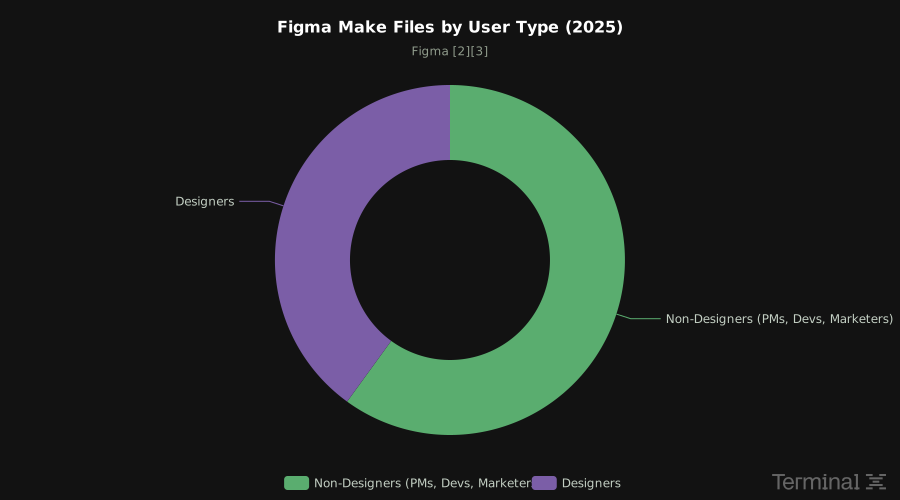
The massive economic performance and behavioral engagement metrics cataloged across Figma's recent platform expansions undeniably confirm the concrete durability of this multi-disciplinary adoption model. The strategic rollout of "Make" — the platform's integrated generative AI solution designed to rapidly transform broad conceptual prompts into editable design layers — drove a massive 70% quarter-over-quarter explosion in specialized weekly active users as of the fourth quarter of 2025. More critically to the core operating thesis, 60% of all files utilizing these specific AI generation features are authored by individuals completely operating outside of conventional design roles, irrefutably proving the tool's sustained capability to successfully capture user intent well beyond pure aesthetic creation. This sprawling, cross-departmental engagement functions as an immensely powerful economic moat for the enterprise suite, cementing Figma as the undisputed system of record for digital output and locking in an exceptional 136% Net Revenue Retention (NRR) rate. By continuously stripping away the technical friction of participation across product managers, institutional marketers, and backend engineers, Figma successfully weaponized its multiplayer infrastructure to transform a niche vector rendering concept into the dominant universal operating system for enterprise problem-solving.
In September 2022, Figma stood at a critical crossroads in its corporate trajectory when Adobe entered the frame with a staggering $20 billion acquisition offer. For an agile platform founded on actively dismantling the siloed infrastructure of legacy design tools, an impending absorption into the definitive incumbent software conglomerate represented a radical shift in destiny. The proposal immediately ignited intense global antitrust scrutiny, thrusting the platform into a suffocating 15-month regulatory review period. During this agonizing operational limbo, the broader technology sector faced severe macroeconomic headwinds, yet Figma was forced to operate with its strategic horizon inexplicably tethered to a proposed integration. The sheer magnitude of the bid permanently distorted the software market's perception of the platform's intrinsic value, establishing an unprecedented $20 billion psychological baseline that would linger over all of its subsequent financial moves.
The protracted standoff inevitably concluded in a mutual termination of the merger in December 2023, as both entities determined that absolutely no viable path existed to secure global regulatory approval. The collapse of the agreement triggered a massive $1 billion reverse termination fee paid directly by Adobe to Figma, instantly infusing the newly independent company with an astonishing reservoir of unencumbered capital. Internally, the executive team moved quickly to stabilize employee morale and realign long-term expectations, explicitly resetting the firm's internal valuation mark to $10 billion to match its 2021 capitalization level. This immediate psychological and structural reset was vital; the company had to abruptly shed its impending subsidiary mindset and rapidly pivot back to operating as a hardened, standalone enterprise capable of sustaining its own market dominance.
Rather than viewing the collapsed acquisition as a strategic failure, management eagerly capitalized on the resulting operational autonomy to fundamentally redefine Figma's overarching corporate identity. Chief Executive Officer Dylan Field positioned the post-merger era not as a defensive retreat to the status quo, but as a direct mandate to transcend the traditional constraints of an isolated design utility. The core realization emerging from the regulatory conflict was that an independent Figma needed to dictate the entire value chain of software development — spanning from unstructured early ideation all the way through to production shipping and measurement. This required a permanent shift in corporate philosophy, pivoting the company's operational focus away from merely out-competing legacy design assets toward establishing a self-sustaining, generational technology cornerstone built upon a diverse, multi-product ecosystem.
The $1 billion cash windfall acted as a formidable accelerator for this newly defined independence, providing Figma with immediate liquidity to pursue strategic mergers and acquisitions at an elevated scale. Even amidst the severe uncertainty of the 15-month regulatory purgatory, the company resolutely refused to stagnate, systematically hiring over 500 new employees, launching physical geographic hubs in the United Kingdom and Asia, and acquiring the artificial intelligence startup Diagram. By weaponizing the Adobe termination capital, Figma funded an intensive research and development pipeline dedicated to weaving foundational artificial intelligence capabilities directly into its unified web canvas. The underlying financial results aggressively validated this resilient posture; the company concluded 2023 generating $600 million in annual recurring revenue, locking in a 40% year-over-year expansion despite the immense organizational distraction of the global antitrust proceedings.
Operating with deep cash reserves and a fiercely autonomous culture, Figma emerged from the Adobe conflict decisively better positioned to execute its platform expansion strategy. Field formalized his intention to maintain definitive operational control over the enterprise's future, laying the preliminary groundwork for an eventual transition to the public markets fortified by a pristine balance sheet and accelerating product velocity. The bitter termination of the $20 billion transaction ultimately forced Figma to stop viewing itself as a lucrative feature to be acquired and integrated by an incumbent titan. Instead, the resulting clarity forged a singularly focused organization equipped to construct an end-to-end product development platform, transforming a sweeping regulatory defeat into the decisive financial catalyst that accelerated its path toward sustainable, institutional scale.
On July 1, 2025, Figma filed its S-1 registration statement to list its Class A common stock on the New York Stock Exchange under the ticker symbol 'FIG'. The filing revealed an economically dominant software entity, bridging the gap from a culturally influential private startup to a public market heavyweight. The foundational financial metrics outlined in the registration demonstrated formidable scale: revenue for the fiscal year ended December 31, 2024, reached $749.0 million, representing a 48% YoY growth rate. This momentum accelerated into Q1 2025, with revenue hitting $228.2 million, a 46% YoY increase. By March 31, 2025, the platform supported over 13 million monthly active users, bolstered by a 132% Net Dollar Retention Rate.
To protect the platform's strategic vision during its transition to a public entity, the company engineered a multi-class stock structure comprising Class A, Class B, and non-voting Class C shares. This governance model established formidable founder-led autonomy, granting Class B shares 15 votes per share compared to the single vote allocated to Class A common stock. Immediately following the IPO, co-founder and Chief Executive Officer Dylan Field controlled 75.3% of the total voting power of the outstanding capital stock. This majority control was fortified by an irrevocable proxy granted by co-founder Evan Wallace and the Wu-Wallace Family Trust, which covered 33.5% of the Class B shares and 25.2% of the overall company voting power. This centralized structure insulated the executive team from short-term market pressures, enabling Figma to execute its long-term product roadmap without external interference.
Approaching its July 2025 debut, institutional demand outpaced the initial supply, driving Figma to revise its marketed price range upward from $25–$28 to a heightened $30–$32 per share. On July 30, the company officially priced the offering above that revised target range at $33 per share, selling 36.94 million shares to raise $1.22 billion. The equity distribution capitalized on the strategic decision to democratize equity and provide liquidity for early believers, generating $412 million in primary capital for the company while unlocking $807 million in secondary proceeds for selling shareholders. This pricing dynamic established an initial base market value of $16.1 billion on outstanding shares, translating to a fully diluted value of $18.5 billion.
The public market reception on Thursday, July 31, 2025, shattered historical technology offering records. Shares opened at $85 and continuously climbed, finishing the trading session at $115.50. This 250% single-day surge marked the largest first-day pop in at least three decades for any United States-traded company raising over $1 billion. At the closing bell, the explosive initial rally propelled Figma to a $56.3 billion market capitalization based entirely on outstanding shares. When accounting for employee stock options and restricted stock units, the fully diluted valuation of the design software maker eclipsed $65 billion.
The magnitude of the debut rally heavily activated specific market mechanics embedded within the company's registration framework. The initial public offering was structurally oversubscribed by more than 40 times the available allocation, fueling immediate secondary market volatility and widespread retail participation. The S-1 featured an "Early Release Condition" within its overarching lockup agreements, stipulating that 25% of restricted shares would be permitted to release after 36 days if the stock price surpassed and maintained a 25% premium above the $33 IPO price for five consecutive trading days. With the requisite threshold set at $41.25, the $115.50 closing price instantly triggered the condition, accelerating liquidity timelines for early investors and employees operating under the standard lockup protocol.
Transitioning seamlessly into a publicly traded operating giant, Figma faced the immediate reality of executing against towering valuation multiples. Trading at the $115.50 closing price, the company commanded a multiple of 68.6x its trailing twelve-month revenue of $821 million. The massive public entry firmly validated its foundational product thesis — that collaborative design had matured into an enterprise-wide necessity requiring a centralized, cloud-native operational layer. The resulting $56.3 billion valuation demanded flawless forward execution, locking the firm into a relentless growth mandate as it formalized artificial intelligence monetization architectures and expanded deeper into global enterprise software budgets.
For much of its early operating history, Figma's footprint outpaced its monetization engine. The collaborative design platform became culturally ubiquitous across the global software development pipeline while historically remaining economically underdeveloped relative to its massive user base. That structural imbalance shifted decisively leading up to its historic public offering and has continued to strengthen materially through its first year as a publicly traded entity. After concluding fiscal year 2024 with $749.0 million in top-line sales, the company successfully scaled total revenue to $1.056 billion for the full fiscal year 2025. This robust expansion maps to a 41% year-over-year revenue trajectory, anchored by a record fourth-quarter closing performance that registered $303.8 million in total revenue, maintaining a 40% year-over-year growth rate that firmly surpassed aggregate market expectations.
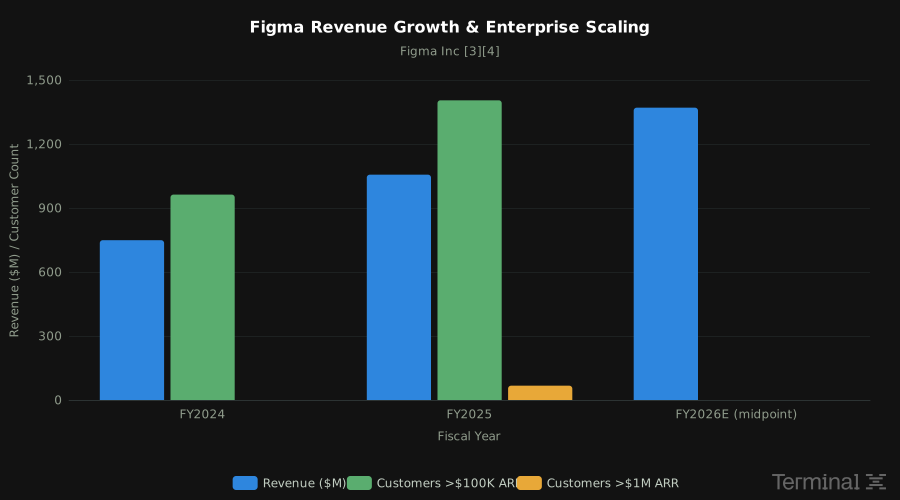
Improved revenue realization is driven directly by institutional adoption and compounding enterprise loyalty. The core operating mechanism of Figma's framework enforces collaborative expansion; as organizations embed the software, practitioners inherently invite non-designers into the centralized canvas, organically driving corporate seat counts upward. This pervasive dynamic yielded a formidable 136% Net Dollar Retention Rate for customers exceeding $10,000 in Annual Recurring Revenue (ARR) during the fourth quarter of 2025, supported fully by an elite gross retention capability of 97%. The upmarket transition accelerated visibly over the past twelve months, with the organization adding 143 net new large-scale clients in the final quarter alone. As of December 31, 2025, Figma commanded 1,405 paid customers contributing over $100,000 in ARR, reflecting a 46% year-over-year baseline expansion. The highest echelon of enterprise spend demonstrated equivalent momentum, with the exclusive subset of customers exceeding $1 million in ARR structurally expanding 68% year-over-year to 67 total operational accounts.
Bridging the gap between persistent active participation and sustained monetization requires analyzing the company's disparate international composition. Dissecting the geographic footprint of user growth adds vital economic nuance to the divergence in realized revenue margins across regions. More than 85% of Figma's 13 million monthly active users reside outside the United States. However, while this international cohort generates immense top-funnel file activity and establishes the platform as a universal global standard, these users contributed just 54% of total quarterly revenue at the formal close of 2025. The domestic United States market, defined by deeper institutional software deployments and concentrated technology budgets, routinely sustains faster conversion cycles from free tiers to premium enterprise contracts. This prevailing dynamic dictates that Figma must aggressively mature its localized commercial infrastructure and direct sales presence in non-English markets to successfully elevate global monetization metrics closer to domestic performance yields.
To accelerate the strategic conversion of this massive, distributed user network into reliable recurring revenue, management initiated a fundamental transition away from a pure seat-based SaaS model toward one operating upon complex, multi-product licensing. The company re-architected its core software suite into discrete functional licenses specifically segmented across Professional, Organization, and Enterprise operational tiers. The standard Professional tier democratizes access at the entry level, extending free foundational utilization to academic demographics while structurally converting independent production teams to paid licenses. The comprehensive Organization and Enterprise plans prioritize broad administrative controls and security compliance, targeting unified corporate technology budgets rather than fragmented individual design software expenditures. Data indicates that 70% of newly contracted Organization and Enterprise deployments natively included at least one user previously operating on a standard Professional plan, validating the direct financial efficiency of this explicit land-and-expand product ladder.
That structural shift expanded further in early 2025 when the company enforced a strategic, persona-based pricing hierarchy expressly enacted to optimize the per-user economic yield. Figma segmented its massive non-designer footprint into strict functionality brackets: Collab seats priced at $3–$5 per month for fundamental file interaction, specialized Dev Mode seats priced at $25–$35 per month tailored exclusively for engineering code extraction, and Full seats commanding $55–$90 per month to encapsulate advanced vector manipulation limits. This pricing maneuver forced corporate clients to map user seats actively against specific functional intent, significantly unlocking Figma's addressable commercial capability beyond the constrained 3.5% of its total user base historically measured as paid participants.
The introduction of generative artificial intelligence directly into the collaborative web canvas fundamentally alters Figma's overarching trajectory, migrating the software from purely qualitative output logic toward metered, consumption-based economics. Over 75% of paid customers actively utilizing the primary $10,000 ARR tier currently consume AI queries on a weekly basis, directly powering a 70% quarter-over-quarter explosion in specialized weekly active users for the company's "Figma Make" generation suite. Tellingly, 60% of all distinct files created utilizing these advanced features in 2025 were authored by non-designers, confirming AI infrastructure as a pivotal adoption catalyst targeting new corporate subsets. To capitalize on this compounding computational volume, the company initiated a hybrid monetization model activating in March 2026, officially establishing standalone AI credit billing in tandem with its standard seat-based subscription framework.
The explicit structural mechanics of the newly enforced credit ecosystem enact strict foundational limits to aggressively shield operating margins against escalating algorithmic inference costs. Beginning on March 18, 2026, individual credit boundaries constrain standard tier configurations at minor 500-credit allocations, while authorizing maximum Enterprise Full seats up to 4,250 monthly generative actions. To sustain algorithmic consumption beyond these initial boundaries, institutional customers face supplementary usage charges, integrating formal $120 monthly subscriptions offering 5,000 expanded credits — effectively pricing localized generative actions at $0.024 — alongside subsequent pay-as-you-go architectures enforcing a 20% billing premium. This decisive implementation of usage-based economics provides substantial forward-looking revenue momentum, precisely underpinning management's formidable fiscal year 2026 financial guidance targeting $1.366 billion to $1.374 billion, representing a 30% implied expansion.
Figma occupies an unusual position in the modern enterprise stack, functioning not merely as an application, but as the critical translation layer where abstract ideation is converted into functional software structure. The broader cloud-based UI/UX market is projected to reach $11.66 billion by 2031, growing at a 32% compound annual growth rate. Within this expanding arena, Figma has transcended its origins as a localized visual editor to become effectively inescapable for product development teams. At organizations like fintech provider Ramp, internal adoption rates have reached 93%, proving that synchronous browser-based editing fundamentally monopolizes enterprise workflows. By centralizing the creative process into a shared, perpetually synchronized state, the platform binds cross-functional teams to its ecosystem, making it financially and operationally prohibitive for departments to export work into disparate outside tools.
"Virtually every Frontier lab is using Figma to design how they bring their models to users and shape their product surfaces."
— Dylan Field, co-founder and CEO of Figma
Field emphasized that because design is inherently non-verifiable, human oversight remains fundamentally necessary even as machine-generated code becomes increasingly accessible. The platform has successfully aligned its architecture to this reality, ensuring that as underlying intelligence models scale in capability, Figma scales proportionally as the central visualization hub for those advancements.
That distinct positioning is materially reinforced by the platform's ability to seamlessly bridge the historical divide between visual creators and backend software engineers. The formal integration of Dev Mode established a persistent operational bridge that translates finalized design concepts directly into production-ready syntax, driving measurable corporate efficiency. A commissioned Forrester Consulting study determined that enterprise deployments of Dev Mode yielded a 351% return on investment and a $7.9 million net present value over three years, while simultaneously increasing developer output by 20–30% and saving individuals over 90 minutes weekly. To capture the inverse flow of the development cycle, the company partnered directly with Anthropic to launch a "Code to Canvas" feature. This mechanism converts artificial intelligence code generated by tools like Claude Code back into editable frames entirely inside the Figma workspace, proving that agentic code generation makes visual design more vital, not less.
Capitalizing on its inescapable position within the core product pipeline, the company has aggressively maneuvered to replace entirely disparate applications across the enterprise software landscape. Over the course of 2025, Figma doubled its core product portfolio from four to eight distinct offerings. The strategic launch of Figma Slides exemplifies this horizontal expansion into legacy corporate territories. Engineered specifically for professional teams, the presentation tool merges simplified slide interfaces with standard design and animation capabilities, allowing users to embed live interactive prototypes and synchronized design libraries directly into operational pitch decks. By enabling real-time collaboration with comprehensive presenter notes, spotlight guidance, and embedded audio chat, Figma Slides actively cannibalizes the market share of traditional static presentation software while keeping corporate dialogue entirely cordoned within the Figma ecosystem.
This aggressive encroachment on adjacent digital territory extends decisively into website publishing through the deployment of Figma Sites. Launched natively from the company's established design environment, the product allows users to construct, animate, and instantly publish fully responsive websites without writing a single line of foundational code. By programmatically transforming existing visual elements configured with Figma's auto-layout system directly into web-compliant formatting, Figma Sites actively eliminates the reliance on external development handoffs for standard web deployments. The platform inherently incorporates design systems, tokens, and overarching stylistic consistency, allowing organizations to bypass third-party platforms such as Framer or Webflow for marketing assets and landing pages. Offering instant collaboration, live cursor tracking, and single-click transitions from theoretical canvas to live domain, the feature consolidates standalone web building into the centralized enterprise subscription.
Through this continuous accumulation of capabilities spanning from foundational user research to direct functional deployment, Figma has manufactured a remarkably deep ecosystem lock-in. The platform no longer competes strictly against legacy graphics editors; it contends simultaneously against dedicated whiteboarding environments, visual presentation software, code generation assistants, and no-code web publishing frameworks. By meticulously connecting these diverse enterprise requirements within a singular, globally synchronized digital environment, the company drastically simplifies corporate vendor procurement while amplifying intra-company user engagement. Contextualizing the firm's competitive posture amid potential software consolidation, Dylan Field projected that "a big part of the platform differentiation we'll have will come from the unification of the surfaces." That unification fundamentally secures Figma's unique position in the digital economy, cementing it as the absolute center of gravity for the modern software development lifecycle.
For much of its early history, Figma positioned itself as the collaborative vessel for human-driven digital design. However, as large language models scale and agentic coding tools effectively eliminate the friction of building software, Figma has adopted an aggressive stance on generative modeling. In a structural shift reminiscent of data-rich platforms realizing the proprietary value of their human-generated archives in the AI era, Figma is pivoting from merely hosting design to actively orchestrating its generative execution. As the mechanical cost of code generation approaches zero, the company operates under the foundational thesis that human "point of view," "craft," and "taste" will rapidly emerge as the ultimate scarce commodities in software development.
The transition begins with acknowledging the limitations of current generative interfaces. Figma Co-founder and Chief Executive Officer Dylan Field views the prevailing method of natural language prompting as a primitive, constrained interaction model, heavily inhibiting the fluid exploration of an AI model's latent architectural space. He notes that while text prompts represent the current baseline, they function more as functional directives than collaborative creative tools. Summarizing this evolutionary phase during a 2025 technology summit, Field made his assessment explicit:
"I think we will look back at this moment in time where prompting and natural language is the primary interface as the MS-DOS era of AI."
— Dylan Field, Co-founder and Chief Executive Officer of Figma
Rather than viewing these models as omnipotent agents capable of autonomous final production, Figma deliberately positions them as accelerants for the preliminary drafting phase. The company's underlying philosophy dictates that human practitioners should not actively fight the models, but rather leverage them to instantly bypass the tedious creation of baseline assets. Field characterizes initial algorithmic output as raw "clay" that fundamentally requires human refinement to achieve commercial viability, explicitly noting that design is inherently non-verifiable by machines. Because models inherently regress toward the mean, generating infinite variations of "good enough" interfaces, true competitive differentiation demands intentional human intervention to eliminate automated "clay" generation and manipulate that raw material into a distinctive final product.
That philosophical framing manifests concretely through the explosive adoption of Figma Make, the platform's proprietary prompt-to-design tool that directly translates natural language into editable canvas elements. The generative product suite achieved massive corporate penetration rapidly following its 2025 deployment, demonstrating robust customer cohort adoption metrics across the enterprise sector. By the fourth quarter of 2025, weekly active users of Figma Make surged 70% quarter-over-quarter. The platform specifically documented deep traction at the highest enterprise tiers, with over 50% of paid customers spending more than $100,000 in Annual Recurring Revenue actively utilizing Make on a weekly basis. Notably, nearly 60% of all files engaging this generative infrastructure were created by non-designers, proving the tool operates as a vital bridge pulling product managers and marketers into the visual ideation pipeline.
To further compress the systemic gap between raw code generation and design refinement, Figma struck a pivotal partnership with Anthropic to architect a bidirectional workflow within the canvas. The resulting integration fundamentally reverses the traditional design-to-code trajectory, allowing users to orchestrate a fluid "round trip" between environments. Utilizing the Model Context Protocol, developers can now capture functional user interfaces generated directly within Claude Code and instantly project them onto the Figma canvas as fully editable layout frames. This synchronization ensures that when an AI coding agent generates a raw application component, human designers can immediately audit, manipulate, and apply enterprise design systems to the output without requiring manual recreation.
That aggressive expansion into generative orchestration deepened critically in October 2025, when Figma completed the strategic acquisition of the Israeli startup Weavy. Founded in 2024 to merge automated generation with professional editing capabilities, the platform was rapidly rebranded and integrated as Figma Weave. Figma Weave operates as a visual, node-based workspace that explicitly unifies disparate, premier AI models — ranging from Sora and Veo for cinematic video generation to Flux for image realism — onto a single browser-based canvas. This architecture fundamentally eliminates the fragmented workflow of operating separate third-party synthesis tools, allowing creators to branch, remix, and color-grade generative multimedia components seamlessly alongside standard digital interfaces.
The acquisition directly reflects Figma's mandate to furnish tools that combine brute computational scale with forensic creative control. By implementing a node-based ecosystem, Figma Weave effectively transforms chaotic algorithmic generation into a structured, reproducible enterprise workflow. This capability enables teams to trace the precise lineage of a generated asset, applying subsequent edits or isolated modifications to lighting and angle without requiring a complete regeneration of the underlying prompt. Addressing the core philosophy behind this fusion of human intent and computational output, Field articulated the boundary separating automated efficiency from final execution:
"Good enough is simply not good enough... you have to push beyond the prompt with design, with craft and with a bold point of view to build something that truly stands out."
— Dylan Field, Co-founder and CEO of Figma
Ultimately, Figma's posture in the AI era assumes that the proliferation of intelligent agents will geometrically multiply the total volume of software produced globally. As autonomous code execution transitions from a scarce technical skill to a ubiquitous commodity, the verifiable quality of the user interface dictates commercial success. By embedding advanced generative modeling entirely within its collaborative infrastructure, Figma ensures its platform remains the mandatory intersection where raw algorithmic efficiency is systematically shaped, governed, and elevated by human intent. In an ecosystem increasingly flooded with infinite machine-driven iteration, Figma's structural bet is that human taste remains the sole enduring moat.
The core financial outcomes of the past year represent a definitive transition from prioritized hyper-growth to sustainable, highly profitable operational execution. Figma successfully eclipsed the billion-dollar milestone in 2025, closing the fiscal year with $1.055 billion in total revenue. That momentum compounded decisively into the fourth quarter, delivering $304 million and maintaining a robust 40% year-over-year expansion rate that comfortably superseded market consensus expectations. Recognizing the compounding structural tailwinds activated by artificial intelligence monetization and aggressive international penetration, management formally issued fiscal year 2026 revenue guidance ranging between $1.366 billion and $1.374 billion. At the $1.374 billion high end, the forward growth mandate reflects an implied 30% expansion trajectory, signaling aggressive confidence in the platform's sustained commercial durability.
Operating leverage is now manifesting directly in structural cash generation, marking a critical turning point for the historically capital-intensive research organization. During the fourth quarter of 2025, Figma secured an adjusted free cash flow of $38.4 million, realizing a refined 13% adjusted free cash flow margin. Across the entirety of fiscal year 2025, the adjusted free cash flow margin reached a broader 23.0%, generating $242.7 million in total holistic yield. Despite this pronounced capacity for outright profitability, the company intends to strategically absorb margin compression in the near term to aggressively protect its technological supremacy. Management explicitly constrained fiscal year 2026 non-GAAP operating income guidance to a $100–$110 million threshold, establishing an 8% operating margin posture entirely designed to absorb the intense, escalating inference costs of foundational artificial intelligence pipelines and the necessary commercial infrastructure required to execute its new hybrid, credit-based billing consumption models.
This financial evolution perfectly mirrors the platform's overarching architectural maturation. Early internet product design existed strictly as a solitary, disjointed pursuit permanently tethered to individually downloaded legacy software and fragile, localized file properties. Figma fundamentally overturned that restrictive paradigm by recognizing that the future of enterprise development necessitated an infinite, persistent browser canvas engineered for concurrent multi-disciplinary action. That structural philosophy completely democratized digital production, proven explicitly by the reality that two-thirds of the platform's active monthly demographics and 60% of specialized Figma Make generative files now originate from individuals operating entirely outside of professional design titles. By flawlessly unifying graphical rendering capabilities with dense, synchronous cloud infrastructure, the platform systematically eliminated the historical friction separating code execution from visual intent.
Ultimately, the impending proliferation of machine learning guarantees a geometric explosion in the sheer volume of software produced globally, shifting the fundamental industry bottleneck from technical coding deployment to verifiable aesthetic quality and human oversight. Figma deliberately positions itself as the mandatory, intent-driven counterpoint to commoditized, purely automated software generation. In an ecosystem where raw algorithmic output increasingly accelerates toward zero cost, the platform guarantees that computational efficiency is continuously governed by human craft. Emphasizing this irreversible dynamic, Chief Executive Officer Dylan Field confirmed that while intelligent coding agents will assume increasingly vast workloads, humans are hardwired to process information visually — dictating that enterprise scaling permanently demands visual interfaces that remain fundamentally auditable and human-readable. Through this unwavering commitment to verifiable collaboration, Figma captures the ensuing creative explosion while structurally ensuring the survival and absolute dominance of the human element in digital design.