Nvidia's $250 Billion OpenAI Backstop and the Semiconductor Slump
What the Reported Guarantee Does (and Doesn't) Buy

I had two windows open on Monday afternoon; the Bloomberg story about Nvidia backstopping a quarter of a trillion dollars of OpenAI's construction debt in one and NVDA's quote page in the other. A year ago that headline would've been a limit-up event. Instead, the stock printed a high of $208.75, gave all of it back, and closed at $196.51, down 4.99%. Meanwhile, SOXX fell 2.05%, extending disastrous one-month declines of 12.49% and 10.31%.
The question everyone over-exposed to the AI trade is asking; whether a $250 billion guarantee is the demand signal semiconductors need to get moving again, or just more evidence that spending is out of control. We went through the reported structure, the balance sheet it would sit on, and the sell-side work that predates it. What we found was a long-dated floor under 2028 and beyond, a near-term ceiling on the group's multiple, and no GPU orders anywhere in sight.
The OpenAI Backstop
Here's how the deal is structured:
- Nvidia would provide credit support of up to $250 billion behind lease and construction financing for a 10 GW AI campus in Pike County, Ohio, developed by SoftBank's SB Energy, with OpenAI as principal tenant.
- No cash moves at signing, and Nvidia's credit sits underneath the project so SB Energy can raise construction debt at a cost that OpenAI, which carries no investment grade rating, cannot command on its own.
- Chips sit outside the guarantee, and Nvidia and OpenAI are separately discussing financing for up to $350 billion of accelerator purchases, and reporting puts total project scope above $500 billion, which is a good reason not to add the two headline numbers together and call it $600 billion.
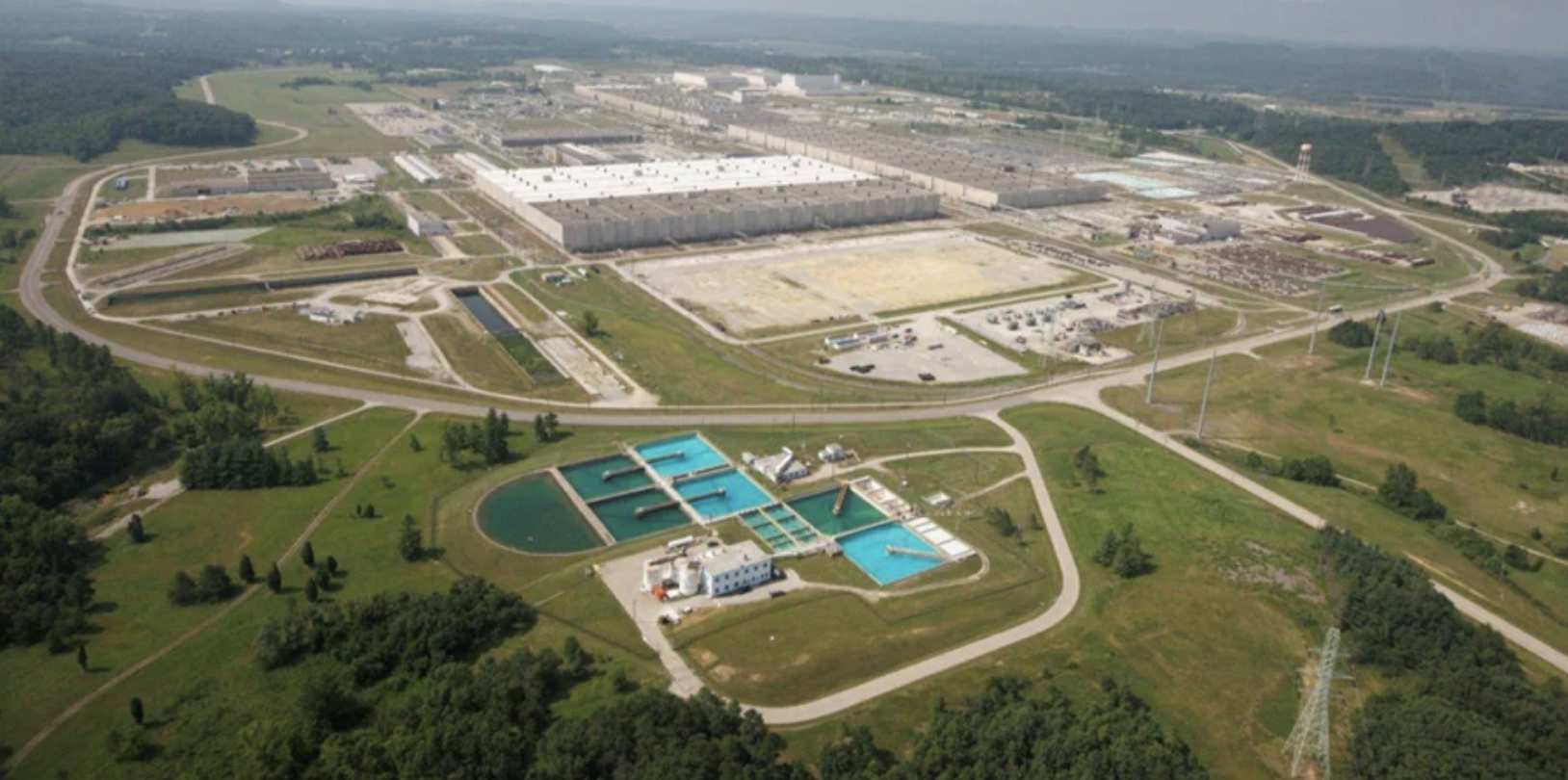
The campus would go up on the site of a former uranium enrichment facility, and at least 9.2 of its 10 gigawatts of electricity could come from natural gas generation, which is to say the critical path runs through turbines, interconnects and permits rather than through TSMC. First capacity of 800 MW is expected in 2028, roughly 8% of the eventual campus, with full completion potentially extending into the mid-to-late 2030s. Discussions are ongoing, terms could change, and as of Monday's close there is no definitive agreement and no transaction-specific SEC filing.
Vendor Finance
Underneath the headline, this is ordinary vendor-supported project finance. As has become the norm for the AI boom, it's simply operating at a scale nobody has attempted before. SB Energy develops the site and raises the debt, OpenAI signs long-dated lease and capacity commitments, lenders take OpenAI credit and completion risk, Nvidia stands behind that risk with a guarantee, and OpenAI separately buys or finances the accelerators that fill the building. Jensen Huang gets something out of every leg of it, since credit support turns compute ambition into financeable capacity, it anchors Rubin and Nvidia networking at a customer that already has AMD and Broadcom relationships, and it widens the system sale after networking sales tripled. The cost is a change in what the company is: supplier, financier, and now credit underwriter to its own largest source of incremental demand.
Bloomberg Intelligence's first read was that guaranteeing a major customer's financing worsens the capex and "circular financing" debate hanging over the buildout, and that is the right instinct. If Nvidia backs the building and separately finances the equipment inside it, the supplier is funding both the facility and the revenue the facility generates. Lenders will not underwrite a 10 GW campus against OpenAI's leases at terms the sponsors can accept, so Nvidia's balance sheet has to fill the gap, and Nvidia can see the order book better than the lenders can.
The Balance Sheet Math
Total assets were $259.5 billion in late April 2026, shareholders' equity was $195.5 billion, and cash equivalents were $13.2 billion, which puts the reported guarantee at roughly 96% of total assets, 1.28 times equity, and 19 times the cash on hand. Nobody should read a number like that as an investment. A guarantee is not a $250 billion cash outflow and probably is not a $250 billion liability at signing. What it amounts to depends on terms nobody has seen: whether the figure refers to principal, lease payments or total supported debt, whether liability is several or joint-and-several, what the draw schedule and expirations look like, what collateral and subrogation rights Nvidia receives, whether SoftBank or OpenAI indemnify anything, and what fee Nvidia gets paid for taking the risk. Until those exist, $250 billion describes potential supported financing and says little about expected loss.
BofA put recent partner investments at $65 billion including the $30 billion in OpenAI, consuming less than 35% of CY26E free cash flow of $187 billion and 17% of CY27E free cash flow of $385 billion, while still leaving room for dividends and repurchases. BofA nonetheless called strategic partner investments a "yellow flag." For context, that flag was raised over $65 billion of equity, cash out the door, loss capped at cost. The reported guarantee is 3.8 times that number, uncapped as far as anyone can tell, and contingent rather than funded. Citi's February read of the 10-K supplies the other half of the picture, with manufacturing, supply and capacity commitments rising from $50.3 billion to $95.2 billion, multi-year cloud commitments reaching $27 billion, and investment commitments at $11.4 billion. Nvidia is already the counterparty on roughly $134 billion of contractual obligations before anyone signs a guarantee.
How We Got Here
In September 2025 Nvidia announced an intention to invest up to $100 billion alongside deployment of at least 10 GW of Nvidia systems, which was the version of this story where capital and GPUs were explicitly linked. By November the company was disclosing that the $100 billion might not materialize, in January reporting described it as a nonbinding letter of intent still under discussion, and February's 10-K said Nvidia was finalizing an investment and partnership agreement while offering "no assurance" that anything would be completed. What happened instead was a $110 billion OpenAI round in February at a $730 billion pre-money valuation, $30 billion each from Nvidia and SoftBank and $50 billion from Amazon, with Nvidia's piece finalized in March at $30 billion and no longer tied to deployment milestones. In March, Huang said the $30 billion "might be the last" before OpenAI's IPO. OpenAI filed confidentially in June at a private valuation near $1 trillion. Four months after the last check, Nvidia is discussing a $250 billion guarantee.
The previous 10 GW framework was announced at $100 billion and closed nowhere near that figure. Assigning committed revenue or committed credit exposure to the current headline ahead of definitive documentation is repeating a similar story. Nvidia has used conditional filing language on this relationship for four straight quarters, and there is no reason to assume the fifth reads differently.
The Slump
Underscoring all of this, the SOX has collapsed 25% as of July 28th.
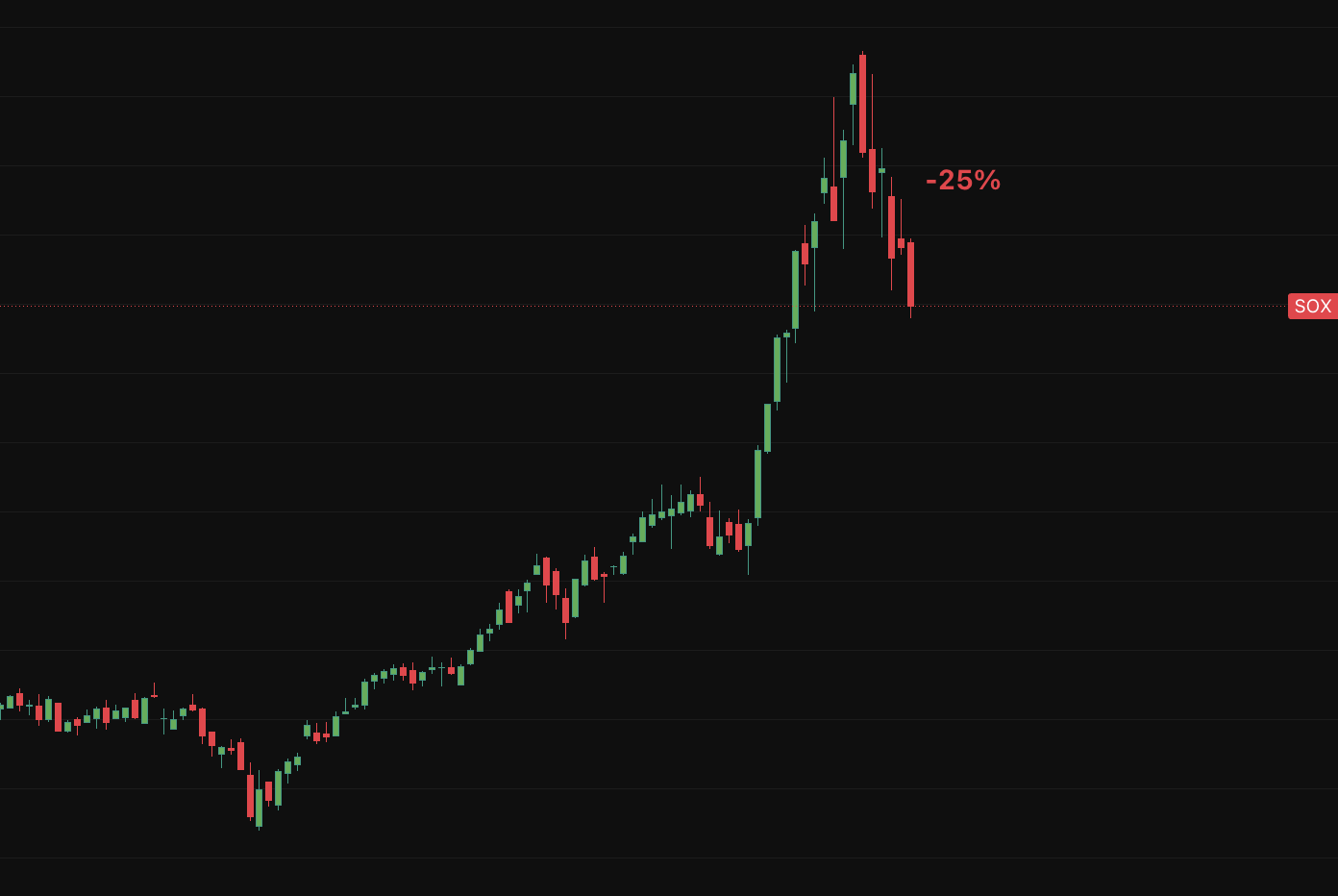
Investors have started requiring hyperscalers and labs to show revenue and utilization against hundreds of billions of committed infrastructure, which Bloomberg tied directly to Monday's decline. Expanded Chinese memory capacity threatens the scarcity and pricing discipline holding up AI-linked earnings, and ASML fell 5.80% on reporting that a Chinese state-backed company is developing competing lithography equipment.
Where the Multiple Sits
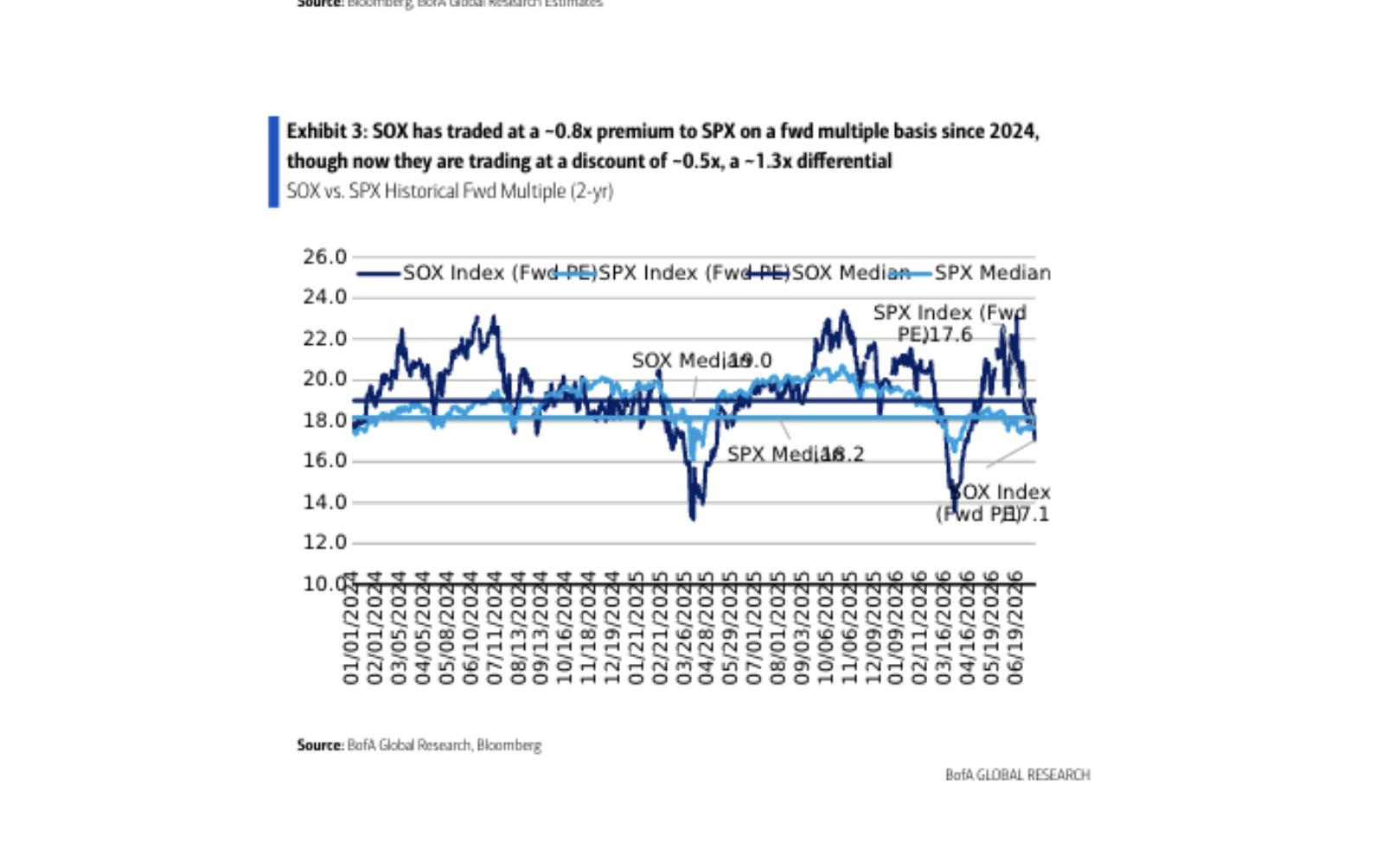
The SOX forward multiple sits at 17.1x against the S&P's 17.6x, a 0.5x discount, where the two-year medians are 19.0x for the SOX and 18.2x for the SPX, an 0.8x premium. That is a 1.3x swing in relative multiple, and it puts the group about 10% below its own two-year median. BofA reads the move as a seasonal reset rather than a fundamental reversal, and the revisions support them: consensus 2026E and 2027E semiconductor revenue moved up 4% and 7% after recent results, EPS up 7% and 8%, with ASML taking the largest revisions, 2026E and 2027E EPS up 18% to $43.96 and $60.57, so prices fell while the numbers went up.
Does This Fix Semis?
A construction guarantee does not create an accelerator order, and there is no disclosed procurement volume, no deployment milestone, no vendor allocation, and the chips sit in a separate conversation that has produced no documentation either. Nothing in the reported structure generates a bookable dollar of semiconductor revenue in 2026 or 2027, so nothing in it can move an estimate. Monday's moves read it exactly that way, with NVDA down 4.99%, AMD down 5.17%, and ASML down 5.80%. A demand catalyst does not usually take the two largest merchant GPU vendors down five points each.
The arithmetic on the other side is enormous. Nvidia's system content runs roughly $40 billion per gigawatt on Blackwell Ultra, $60 billion to $80 billion on Vera Rubin, and potentially $100 billion on Feynman. Those are content and efficiency frameworks rather than guidance for Ohio, but run 10 GW through the Rubin range and you get $600 billion to $800 billion of Nvidia system content, which makes the separately reported $350 billion chip financing discussion look like roughly half a campus. The first 800 MW alone is $48 billion to $64 billion on the same math. Spread across accelerators, server CPUs, HBM4, leading-edge wafers, CoWoS packaging, optical and electrical networking, power silicon, and the fab equipment underneath all of it, this is a terminal-demand and capacity-planning story, not a 2026 earnings story.
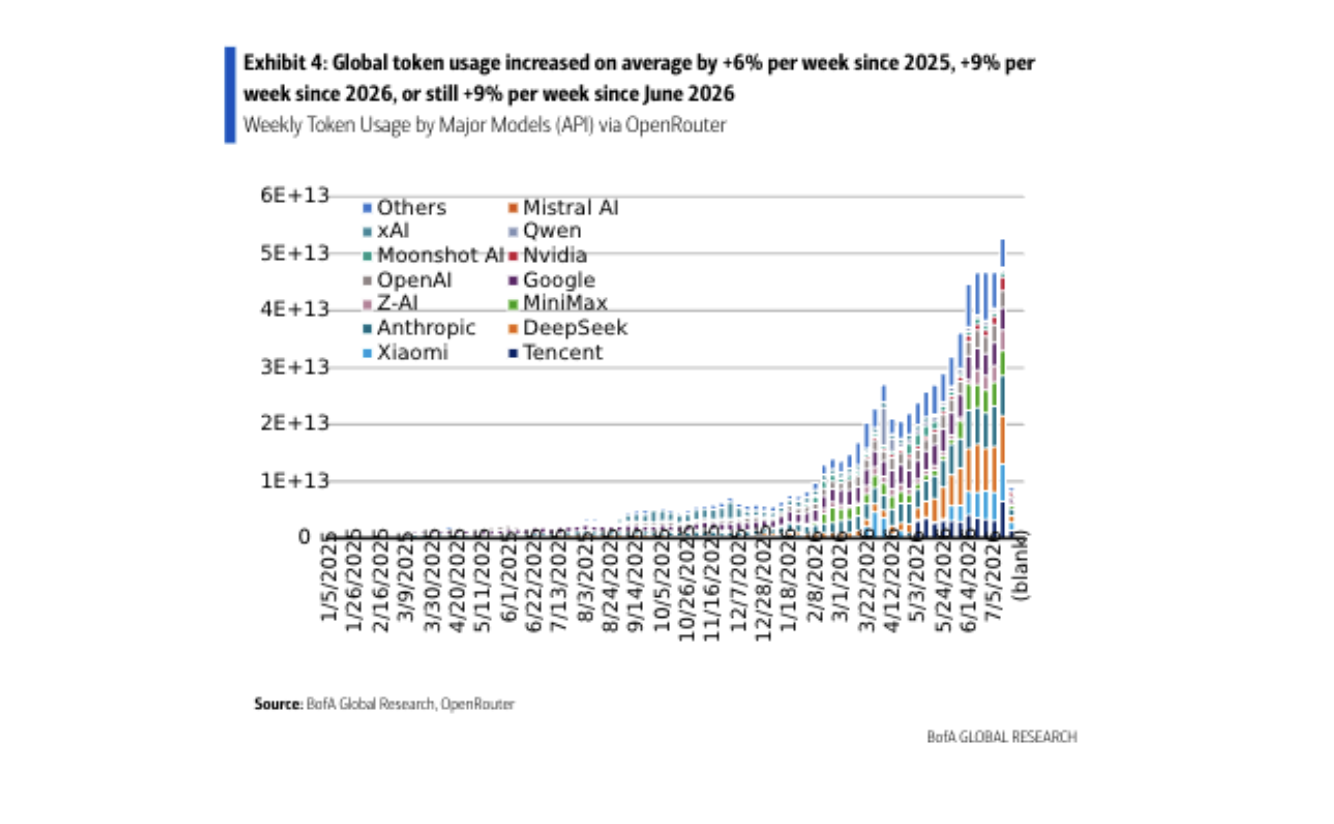
Which leaves the question the market is asking, whether the compute gets consumed and paid for without a guarantee attached to it. Off BofA's OpenRouter series, weekly token usage across major model APIs has compounded at 6% per week since 2025 and 9% per week since January, and it held that 9% rate from June into July rather than decaying. 9% a week compounds to something like 13x over the 30 weeks of 2026 so far, and the chart bears that out, moving from under 5 trillion tokens per week in January to above 50 trillion by early July. Consumption is doing its part, and revenue per token, utilization and customer cash generation are the numbers nobody has produced, which is why the guarantee exists at all.
The Capacity Chain
BofA has Nvidia holding 67% of accelerator sales by 2030E, worth $756.5 billion, and Broadcom at 16%, worth $179.6 billion. Run those backwards and BofA's implied 2030E accelerator market is about $1.13 trillion, roughly 20% below the $1.4 trillion data-center accelerator TAM AMD puts in its own deck, which is a useful reminder of whose forecast you are buying when you buy the theme. TSMC gets paid on all of it regardless of who wins, raised 2026 capex guidance to $60 billion to $64 billion, and announced another $100 billion for Arizona.
Equipment gets paid later and harder, with BofA carrying WFE at $144 billion in CY26, $190 billion in CY27, and $250 billion in CY28, up 32% and 32%, and leading-edge WFE compounding at 22.3% from CY25 to CY30E as TSMC, Samsung, Intel and Rapidus all push below 5nm. The equipment names have been sold the hardest, with LRCX, AMAT and KLAC down 29%, 27% and 31% quarter to date by July 22 while the two-year WFE outlook they sell into rose 74%. Memory sits in the same dislocation with more operating leverage attached, since HBM remains the binding constraint on compute supply and the constraint has not loosened.
None of that demand is sourced from Ohio. Google raised FY26 capex guidance to $195 billion to $205 billion against $91 billion in FY25, which Citi read as positive for Nvidia and Broadcom, and Citi has hyperscaler capex growing 84% in CY26, 56% in CY27, and 38% in CY28. Compound those three and the hyperscaler capex base nearly quadruples between CY25 and CY28 even as the growth rate more than halves twice over. That is the floor under semiconductors, and it exists whether or not anything gets signed in Pike County.
Final Thoughts
The bull case, stated at its strongest, is that Nvidia is doing the only thing a supplier with $385 billion of CY27E free cash flow and no credible competitor should do, which is use its credit to make projects financeable that nobody else can make financeable, converting a balance sheet advantage into 10 GW of Rubin sockets, HBM4 pull-through and networking content that AMD and the ASIC vendors cannot match, at a moment when the group trades at 17.1x forward, 10% below its own median, with revenue and EPS estimates revising up, WFE headed to $250 billion by CY28, hyperscaler capex nearly quadrupling in three years, and token consumption compounding 9% a week without slowing. If the accelerator financing converts into a binding order tied to completed megawatts, every number in this post is too low.
The bear case is that a supplier holding $13.2 billion of cash is contemplating a contingent obligation 1.28 times its own equity on behalf of a loss-making private tenant that lenders will not underwrite standalone, secured by collateral nobody has disclosed, priced at a fee nobody has disclosed, behind a gas-fired campus on a former uranium enrichment site whose first phase is two years out and whose last phase is a decade out, where the silicon inside depreciates far faster than the buildings and turbines around it while the debt matures on its own schedule, where the same company already carries $134 billion of contractual commitments and wrote a $5 billion check to Safe Superintelligence on the same day this leaked, and where the previous version of this exact partnership was announced at $100 billion in September 2025 and quietly disclosed as maybe-not-happening eight weeks later.
Both can be true. The guarantee can put a floor under 2028 and beyond while doing almost nothing for 2026 estimates, and a group already worried about financed demand will not re-rate on the largest piece of financed demand yet proposed. Semiconductors rebound on earnings, capex revisions and binding orders, in that order, and the capacity chain gets paid on all three regardless of which accelerator wins. The next real datapoint is documentation on the $350 billion of chips, and nobody has a date.
More insights

Introducing VaR
Value at Risk, for frontier models. A finance LLM benchmark for asset managers: AI models evaluated on 9 private eval sets built from 259 real buy-side workflows.

Private Credit Crisis: Bubble or Business as Usual?
Looking for stability in an opaque industry

From AI Agents to Institutional Memory: What's Next for Real Estate
Terminal X London with DWS | How AI is transforming Real Estate Investment: from underwriting and asset management