The Financials Behind the SpaceX IPO
A Look Inside the Largest Public Offering in History
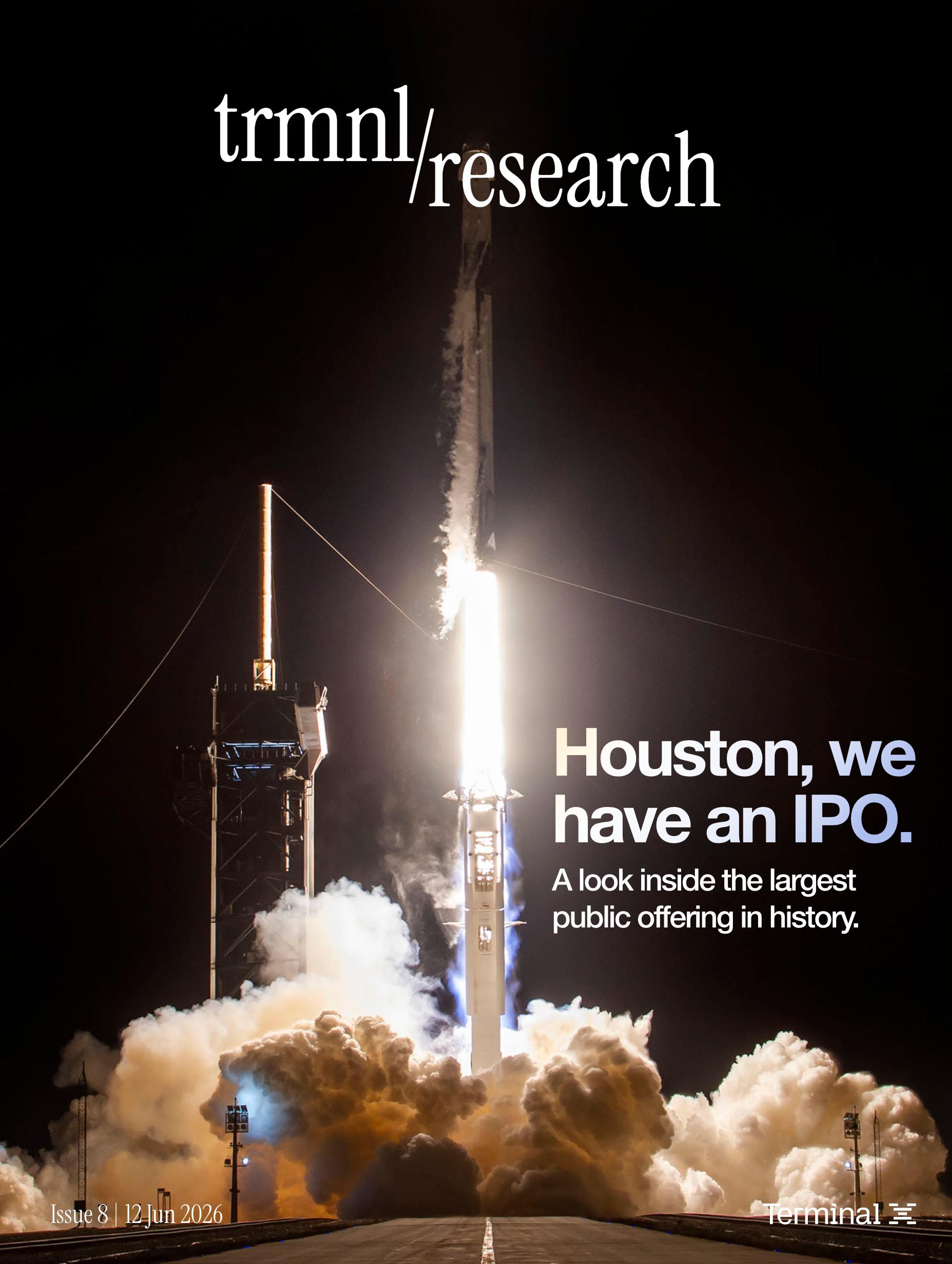
June 12, 2026
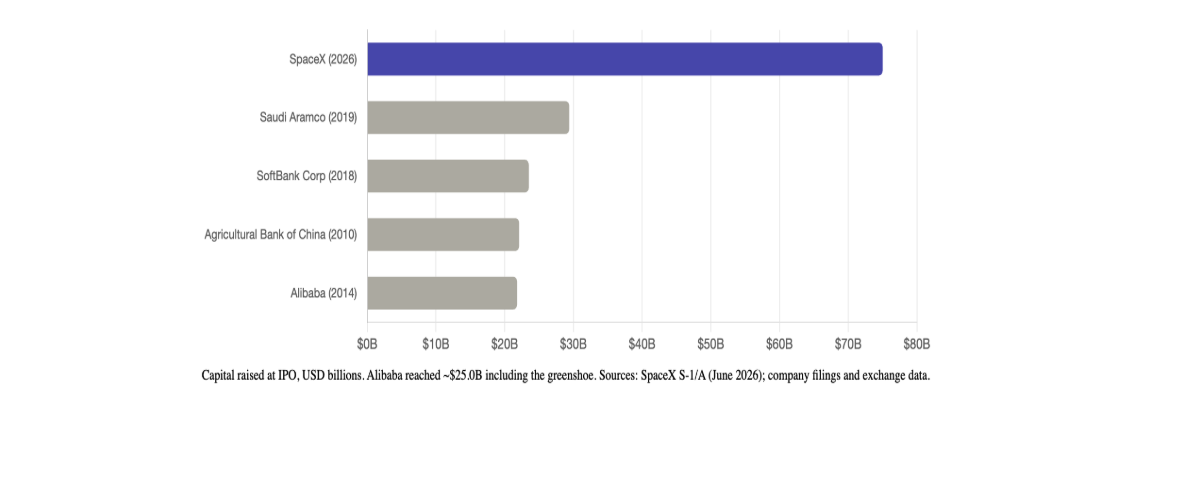
I watched the SpaceX IPO open this morning the way most of us did, refreshing a quote page and waiting for a first trade that took an extra half hour to print. The Nasdaq delayed the open to roughly 9:50 AM ET while underwriters manually built the matching pool, the same routine we saw with Meta and Alibaba, except this time the deal was more than three times the size of anything that came before it. SPCX priced Thursday night at $135 per share, sold 555.6 million Class A shares, raised $75 billion, and opened at $150 before running as high as $176.50 intraday, briefly pushing the market cap past $2.2 trillion. It closed at $160.95. For context, Saudi Aramco's $29.4 billion raise in 2019 held the record for almost seven years, which SpaceX swiftly lapped two and a half times.
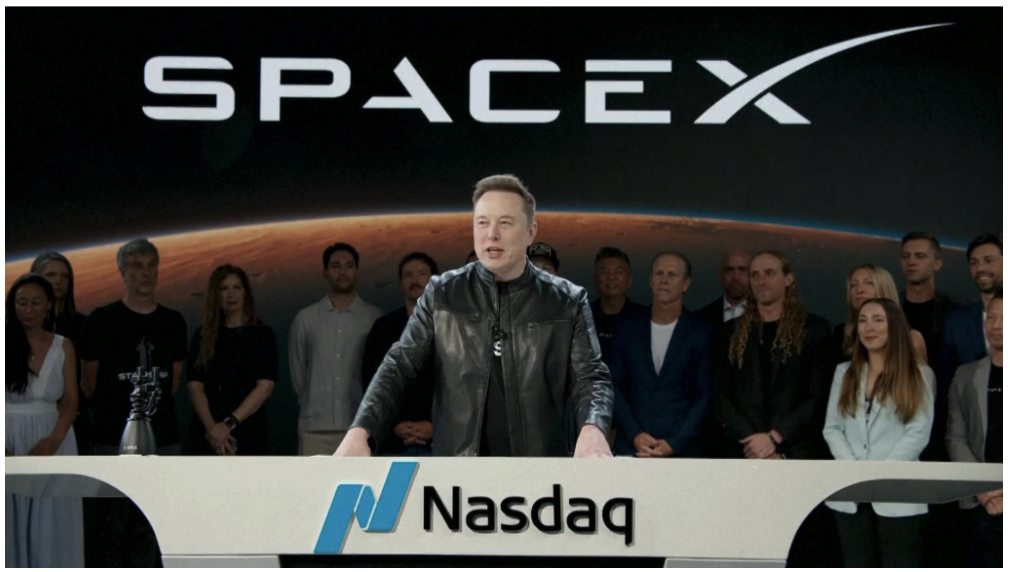
And Musk is a trillionaire. He stood at Starbase behind a Nasdaq podium this morning, with Gwynne Shotwell and CFO Bret Johnsen ringing the bell in New York. Does a $1.77 trillion price tag on an $18.7 billion revenue business with a $4.9 billion net loss make sense? With Musk, part visionary, part retail-trader-whisperer, does anything have to? We spent some time going through the S-1 along with its two amendments. What we found was part rocket company, part telecom, part frontier AI lab, and part referendum on one person.
How We Got Here
The timeline to IPO was made deliberately fast. SpaceX confidentially filed a draft S-1 with the SEC on April 1, 2026. The public S-1 hit EDGAR on May 20, giving the public its first real look at financials the company had guarded for 24 years. Amendment No. 1 landed June 1, Amendment No. 2 on June 3 with the fixed $135 price, the roadshow kicked off June 4 ahead of schedule after a quicker than expected SEC review, and the registration statement was declared effective June 11, and books closed a day early. The freshly christened SPCX ticker went from confidential filing to first trade in 72 days, remarkably fast for the largest offering in history.
The structure is an all-primary offering, meaning that every one of those 555.6 million shares is newly issued, with all $75 billion in proceeds flowing to the company. No existing shareholder, including Musk, sold a single share into the deal. Meanwhile, Musk and existing holders are required to hold their shares for 366 days post-IPO, a full year, which is meaningfully longer than the standard 90 to 180 day tech lockup (Wedbush - Ives, Wahrhaftig, Brandeis, Jog, "SpaceX IPO on Deck"). This can be read in two ways, one charitable (showing a certain “commitment” to the company), while the other cynical (“float engineering”, which will be discussed in the coming section).
The syndicate itself ran 21 banks with Goldman Sachs lead left and Morgan Stanley, Bank of America, Citigroup, and J.P. Morgan among the book-runners. Underwriters also hold a 30-day greenshoe for up to 83.3 million additional Class A shares. The S-1/A disclosed a 5% directed share program reserved for employees and people selected by executive officers, including, in the filing's own framing, “business relationships and friends and family of executives”, and those shares carry no lockup at all.
Headlines peppered the WSJ and the finance world in the days leading up to the IPO. Demand by all accounts, was insatiable. Reuters reported the book ran 3.5x to 4x oversubscribed with more than $250 billion in total demand. BlackRock alone ordered $5 billion of stock, as sovereign wealth funds piled in, and a single family office requested over $1 billion (Wedbush). Retail, originally expected to receive around 30% of the deal (an unusually large allocation that SpaceX itself had floated) got cut to the low 20s as institutional orders greedily crowded the book.
The Numbers
Let’s take a (consolidated) look into Space X’s finances.
In FY2025, SpaceX generated $18,674 million in revenue, a loss from operations of $2,589 million, and Adjusted EBITDA of $6,584 million. Net loss for the year was $4.9 billion. Revenue grew 33% year over year from roughly $14.1 billion in 2024. For the first quarter of 2026, revenue was $4,694 million (up 15% year over year), while the loss from operations was $1,943 million, and Adjusted EBITDA came in at $1,127 million. We have a company growing 33% at an $18.7 billion run rate that loses billions of dollars on a GAAP basis while generating billions in adjusted EBITDA. The company itself is broken into three reporting segments, Space, Connectivity, and AI.
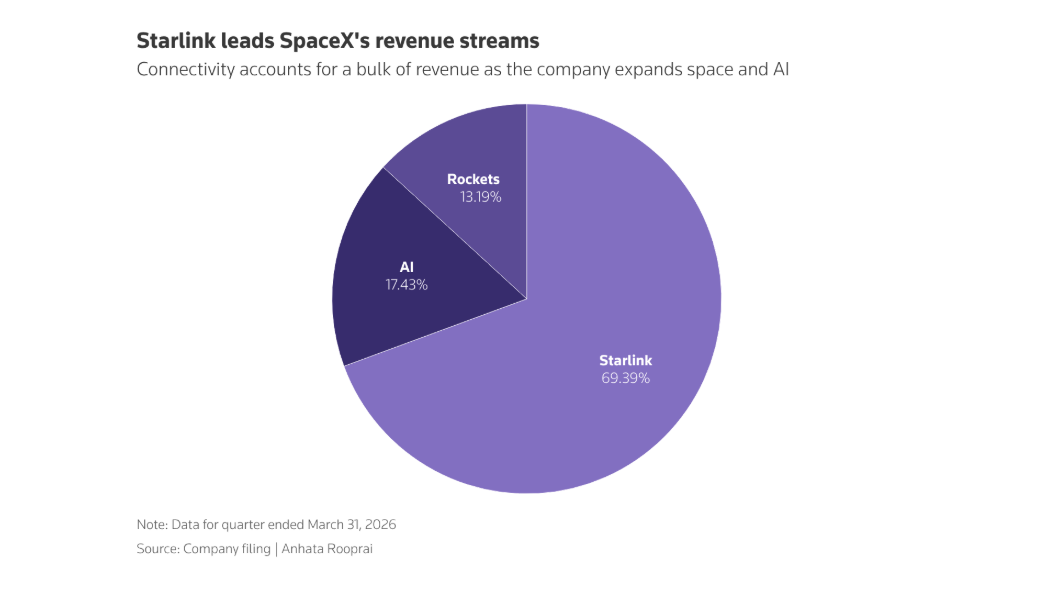
Connectivity, which is primarily Starlink, did $11,387 million in 2025 revenue with $4,423 million in income from operations and $7,168 million in segment adjusted EBITDA. Year over year growth on those three lines was 49.8%, 120.4%, and 86.2% respectively. Incredibly, Starlink accounts for 61% of total company revenue at a 39% operating margin, making it the (rocket) engine that helps pay for everything else within the company.
“Space”, the actual rocket business of Falcon, Dragon, and Starship, did $4.1 billion in 2025, up only 8% year over year, and lost money. In Q1 2026 the segment generated $619 million in revenue against a $662 million operating loss. Importantly, the losses are not a demand problem, rather a Starship problem. Per Via Satellite's read of the filing, the segment spent close to $3 billion on R&D for Starship development in 2025 alone.
AI, the segment created when SpaceX completed its acquisition of xAI in February 2026 (now branded SpaceXAI in the filing, encompassing Grok, the X platform, and compute infrastructure), generated $3.2 billion of 2025 revenue and lost $6,355 million for the year. In Q1 2026 alone the segment did $818 million in revenue against a $2,469 million operating loss. That is roughly $2.5 billion of losses per quarter, which seems to only be accelerating.
The capex table speaks honestly about the company’s priorities. In Q1 2026, capital expenditures were $1,052 million for Space, $1,332 million for Connectivity, and $7,723 million for AI. Space X spent seven times more on AI infrastructure in a single quarter than on rockets, operating as an AI company that happens to own the world's best launch and connectivity assets.
Starlink
Starlink subscribers grew from 2.3 million at the end of 2023 to 4.4 million in 2024 to 8.9 million in 2025, and reached 10.3 million as of March 31, 2026, served across 164 countries, territories, and markets. The constellation stands at roughly 9,600 broadband and mobile satellites in low Earth orbit, which the filing notes is about 75% of all active maneuverable satellites in orbit; one third of everything humanity has in orbit that can steer itself belongs to Musk and co.
Once the constellation exists, each incremental subscriber arrives at near-zero marginal cost, which is why 49.8% revenue growth converted into 120.4% operating income growth. This was essentially a price trade-off, as average revenue per user fell from $99 per month in 2023 to $66 per month by the end of Q1 2026 as SpaceX bought global volume with lower prices. Then, in May 2026, weeks before the IPO, the company raised Starlink plan prices by up to $10 per month, pivoting from land-grab pricing to monetization, immediately before asking public markets for $75 billion.
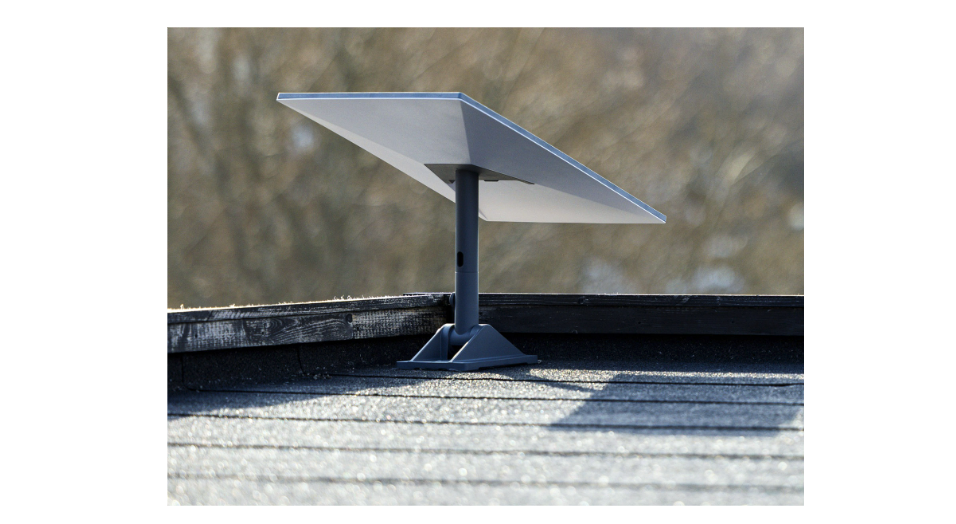
Secondary within the connectivity category (for now) is “Starshield”, the government and defense version of Starlink. Disclosures within the filings are comparatively and reasonably limited, but third-party analysis puts Starshield revenue around $1.8 billion with multi-year contracts with the National Reconnaissance Office and other US government customers, growing faster than nearly everything else in the company.
The AI Gambit
With public funding, perhaps Musk plans to attempt to close the gap between his xAI lab and his competitors, Anthropic, Google, and OpenAI, among others. The use of proceeds section lists expansion of AI compute infrastructure first, ahead of Starlink and ahead of Starship. The AI segment is burning $2.5 billion a quarter and management plans to, in the filing's language, prioritize growth and investment in the segment. Q1 AI capex of $7.7 billion annualizes to over $30 billion, which is hyperscaler territory, and the company is standing up credit facilities and investment-grade ratings to borrow more on top of the $75 billion raise. The xAI merger in February 2026, which folded Grok, the X platform, and xAI's data centers into SpaceX, was the corporate prerequisite for all of it, and as Wedbush noted, it had the side effect of converting Tesla's $2 billion xAI investment into SpaceX shares, formally entangling Musk's two flagship companies for the first time.
Filings also describe sci-fi-esque plans for orbital AI compute, data centers in space powered by solar, with deployment of orbital AI compute satellites beginning as early as 2028. This week, days before pricing, SpaceX unveiled AI1, its first compute satellite, carrying a 150-kW peak compute payload with deployable liquid cooling, built by repurposing Starlink V3 power, cooling, and laser-link hardware into an orbiting compute platform (per the June 12 Wedbush note). Quite simply, launch is the bottleneck for orbital compute, SpaceX owns launch, therefore SpaceX owns orbital compute. Whether the unit economics of computing in a vacuum ever beat a data center in Iowa is a completely open question that nobody, including SpaceX, can answer yet. Kiplinger put it plainly in their IPO coverage: the economics of AI data centers in space are a “big question mark”.
This is where the company's stated total addressable market becomes somewhat of a Rorschach test. Wedbush relays the company's own framing: a $28.5 trillion addressable opportunity, split across $370 billion in space-enabled solutions, $1.6 trillion in connectivity ($870 billion Starlink broadband, $740 billion Starlink mobile), and $26.5 trillion in AI, of which $22.7 trillion is enterprise applications, plus $2.4 trillion in AI infrastructure, $760 billion in consumer subscriptions, and $600 billion in digital advertising. Given that 93% of the claimed TAM sits in a category the company entered four months ago via merger, this seems more like hype marketing than anything.
Governance
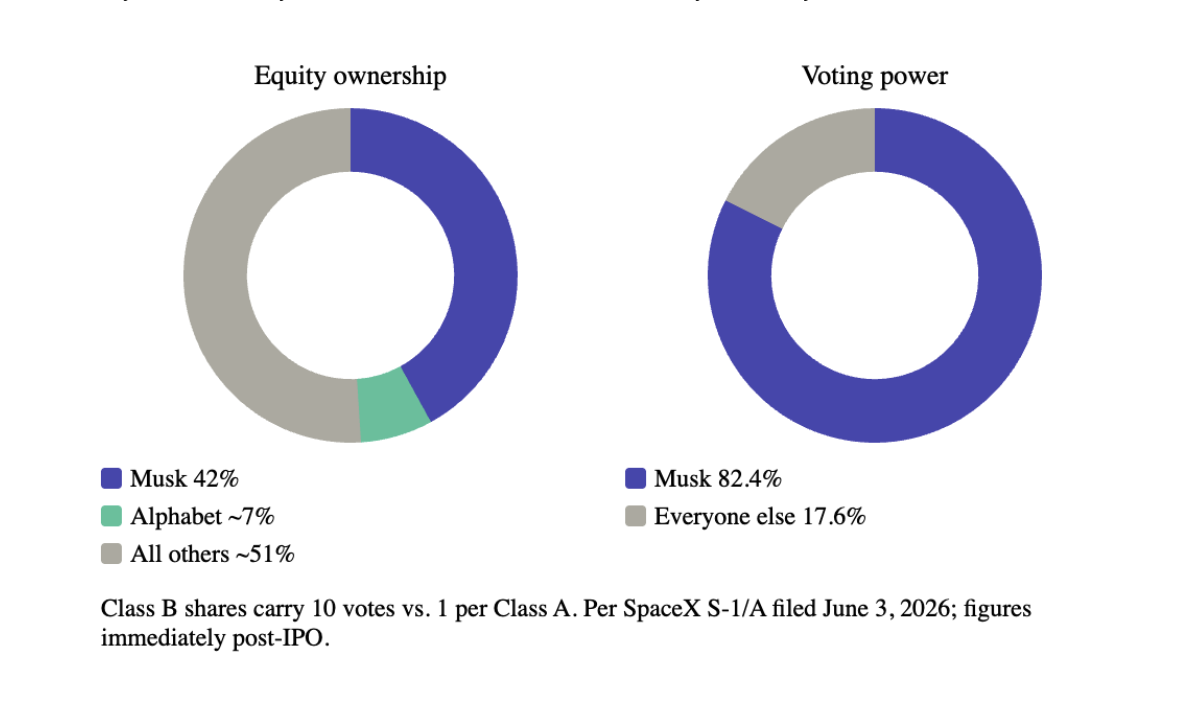
SpaceX listed with a dual-class structure. Class A shares, the ones sold today, carry one vote. Class B shares carry ten. Per the S-1/A filed June 3, Musk holds approximately 42% of the equity and will control 82.4% of total voting power immediately following the IPO (some earlier coverage cited 79% from the May 20 filing). SpaceX will be a controlled company under Nasdaq rules, exempt from independent board majority requirements. Musk can only be removed from his roles as CEO, CTO, and Chairman by a vote of Class B shareholders, which is to say, by himself.
SpaceX adopted a mandatory binding arbitration clause for all shareholder disputes, with shareholders irrevocably waiving jury trials and prohibited from bringing class actions against the company, its directors, officers, or controlling shareholders. Kiplinger's coverage flagged it as likely the first major US company to go public with that provision. Combined with the dual-class math, the package is unambiguous: public shareholders receive economic exposure and essentially zero governance rights or legal recourse.
The S-1's risk factors list key-person concentration around the founder as a core risk, alongside launch failure rates, Starship delays (which topped the risk list), regulatory exposure on Starlink spectrum across multiple countries, and government contract dependence. You cannot separate the asset from the man, contractually or practically, and the filing is engineered to keep it that way. Still, it is likely that retail investors wouldn’t have it any other way.
The Float Problem
SpaceX sold 555.6 million shares against a company valued around $1.77 trillion at pricing, meaning the free float at listing is on the order of 4% of the company. Existing holders are locked for 366 days. The only unlocked shares beyond the IPO allocation are the 5% directed share program, creating the most anticipated listing in a generation, $250 billion plus of demand chasing $75 billion of paper, a retail allocation that got cut at the last minute, and a float so thin that today's $33 billion in SPCX dollar volume exceeded what traded in QQQ and SPY combined.
Then there are the index mechanics. Under Nasdaq's fast-entry framework, a newly listed company can join the Nasdaq-100 after just 15 trading days if its market cap ranks inside the top 40 constituents, which SPCX clears trivially, with float-adjusted weighting handling the thin float. Russell inclusion could come within roughly five trading days. S&P 500 entry is off the table for now given the profitability requirement, with estimates pointing to mid-2027 at the earliest. The practical consequence is that within weeks, passive funds holding trillions in retirement savings will be forced buyers of a stock with a single-digit float, regardless of any view on fundamentals. As one analyst put it in NBC's pricing coverage, there's been a manufactured drama around index inclusion, but manufactured or not, the flows are real. Wedbush's June 12 note also observed investors selling existing tech holdings to fund SPCX positions, so the rotation effects cut both ways across the sector.
The next six months of SPCX price action will tell you very little about SpaceX the business and quite a lot about supply and demand for a scarce ticker. The first real fundamental data point arrives with the inaugural earnings call expected in September 2026, and the first real supply event is the lockup expiration window beginning around December 2026. What will happen between now and then is highly speculative.
Worth $1.77 Trillion?
SpaceX closed up 19% on its first day of trading. Even at its $135 IPO price, $1.77 trillion against $18.7 billion of 2025 revenue works out to about 95 times trailing sales. Against $6.6 billion of adjusted EBITDA it's roughly 268 times. At today's close of $2.1 trillion, these all get stretched another 25%. So what are the options?
The bull case, plainly stated, is that you are paying 95 times sales for a monopoly position in orbital launch, the fastest-scaling telecom in history (subscribers nearly doubling annually with structural margin expansion), a credible frontier AI lab with a captive distribution platform in X, and an unrepeatable option on the orbital compute thesis, all run by the most effective industrialist alive, with $75 billion of fresh capital and investment-grade credit to (hopefully) compress every timeline. If Starlink reaches 30 or 40 million subscribers at recovering ARPU, if Starship hits cadence, if even a fraction of the orbital compute story works, the 2030 numbers retire the 2026 multiple.
The bear case on the other hand is a company that lost $4.9 billion last year, where the profitable segment's growth is funding an AI segment burning $10 billion annualized in a market where it is, at best, the fourth or fifth lab by capability, where the moonshot that justifies the multiple (compute in orbit) has zero demonstrated unit economics, where the controlling shareholder is unremovable, unsuable in court, and famously distractible, and where the float mechanics that produced today's pop are precisely the mechanics that produce ugly air pockets when sentiment turns or lockups expire.
Where does Terminal X land? Find out.
More insights

Nvidia's $250 Billion OpenAI Backstop and the Semiconductor Slump
What the Reported Guarantee Does (and Doesn't) Buy

Introducing VaR
Value at Risk, for frontier models. A finance LLM benchmark for asset managers: AI models evaluated on 9 private eval sets built from 259 real buy-side workflows.
Private Credit Crisis: Bubble or Business as Usual?
Looking for stability in an opaque industry