What "Agentic AI" Actually Means in Finance and Why Investment Teams Need to Care
Agentic AI is live at top buy-side firms. Learn what it does, how it works, and what to evaluate before deploying.
The term "agentic AI" is everywhere right now. Every software vendor, every consulting firm, every conference panel has adopted it. Most are using it to mean something slightly different. A few are using it to mean nothing at all.
For investment professionals (analysts, portfolio managers, research teams) this matters more than it does for anyone else in finance. Because there is a big distinction between a system that assists research and one that executes it autonomously. It's the difference between a smarter Bloomberg terminal and a system that can run a substantial portion of your research workflow without waiting to be asked.
This article cuts through the noise. Agentic AI, in plain terms, is AI that acts autonomously, completing multi-step research workflows without waiting for a human prompt at every step. We will explain what that actually means in practice, how it differs from the generative AI your team is already using, where it's genuinely being deployed in investment research today, and what the honest limitations are. There are several.
Key Takeaways
- Agentic AI completes multi-step research workflows autonomously. It doesn't need a prompt at every step.
- The core difference from generative AI is when asked, agentic AI acts toward a goal on its own.
- Investment research is especially well-suited to agentic AI because data is fragmented, unstructured, and time-sensitive
- Leading buy-side institutions are already in production: Hana, Point72, Balyasny, BlackRock, and JPMorgan all have active deployments
- The non-negotiable requirements for institutional use are source traceability, access controls, audit trails, and human-in-the-loop checkpoints
- 44% of finance teams will deploy agentic AI in 2026, a 600%+ increase from the prior year (Wolters Kluwer, 2025)
What Agentic AI Actually Is
Agentic AI refers to AI systems that can plan, decide, and take multi-step actions autonomously in pursuit of a defined goal, without requiring a human prompt at every step. Unlike a standard AI model that answers one question at a time, an agentic system can receive a high-level objective, break it into sub-tasks, call the tools it needs, evaluate the results, and continue iterating until the goal is complete.
The key properties that make a system "agentic" are:
- Autonomy: it initiates actions without waiting for input at each step
- Goal-directedness: it works toward an outcome, not just a single response
- Tool use: it can call external systems (databases, APIs, web search, file systems)
- Memory: it retains context across the steps of a workflow
- Self-correction: it can evaluate its own outputs and adjust course
A standard chatbot has none of these properties beyond the first exchange. It answers the question you asked, and it stops. An AI agent is given an objective ("research this company's supply chain exposure and flag any material risks") and it runs. It searches filings, retrieves relevant transcripts, compares against peer disclosures, and surfaces a structured output. All without you directing each step.
Agentic AI vs. Generative AI
Most investment teams have been using generative AI for 12 to 24 months. You've used it to summarize earnings calls, draft memos, and query documents. Generative AI is a model that produces outputs in response to prompts. It's reactive. You ask, it answers. It doesn't do anything when you're not looking.
Agentic AI differs from generative AI in one fundamental way. Autonomy over time.
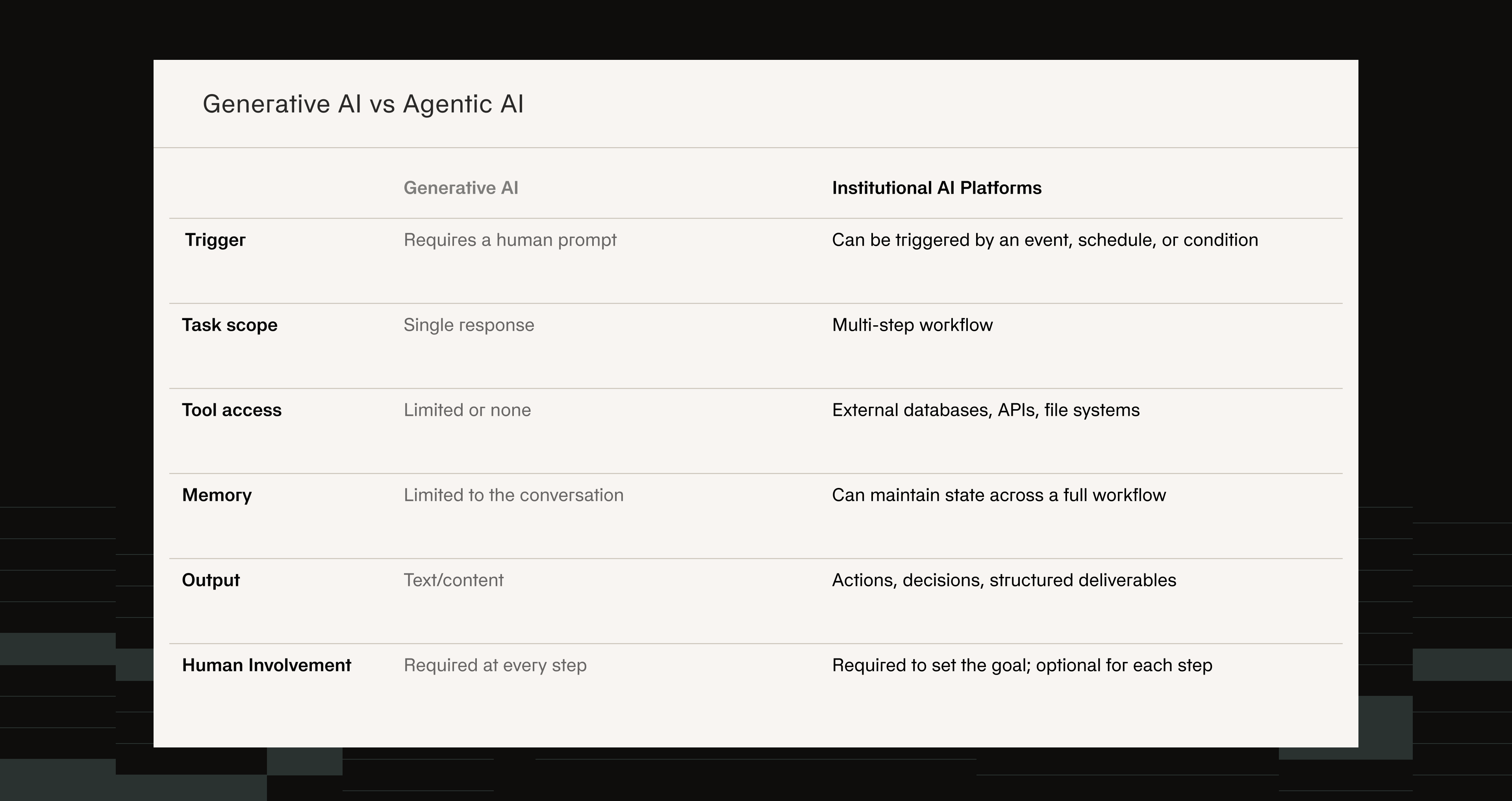
So generative AI makes you faster at doing your job. Agentic AI handles parts of your job on its own, under your oversight.
- "Generative AI waits for a prompt. Agentic AI waits for a condition. That single distinction determines whether AI is a productivity tool or a workflow layer. In investment research, the difference is the entire value proposition."
The spectrum between the two isn't binary. There's a middle ground occupied by what Anthropic and others call "workflows" (predefined sequences where a model performs structured tasks in a set order, but doesn't decide its own next step). True agentic systems like Terminal X go further by determining their own sequence of actions based on what they observe.
For investment professionals, it determines what you can actually automate, what you can trust, and where human judgment remains non-negotiable.
Why Finance Is Defined by This Distinction
Most industries can use AI as a drafting assistant and extract meaningful value from it. Finance can too. But the investment workflow has specific properties that make the generative-to-agentic shift unusually consequential.
Research is relentlessly time-sensitive. The value of most investment insights decays quickly. An analyst who needs to assess a company's exposure to a new trade policy within two hours can't afford a research process that requires constant manual prompting. A system that can run the analysis end-to-end while the analyst is in a meeting is qualitatively different from one that helps them do it faster.
The data surface is enormous and fragmented. The average institutional research team draws from SEC filings, earnings transcripts, broker research, alternative data, macro feeds, internal models, and proprietary notes, across a dozen or more disconnected systems. Generative AI helps you process one document at a time. Agentic AI can be given access to the full data environment and tasked to synthesize across all of it simultaneously.
Signal is buried in unstructured sources. The most differentiated insights rarely come from structured data alone. They emerge from the intersection of an obscure 8-K footnote, a management comment from a transcript six quarters ago, and a supply chain disclosure from a supplier's investor day. Connecting those dots manually is expensive. An autonomous research agent can be configured to make those connections continuously.
The competitive pressure is acute. In Q1 2026, 41% of hedge fund managers surveyed by Hedgeweek ranked AI integration into their investment processes as their single biggest priority for the year, ahead of cost optimization and talent acquisition, which have historically dominated these surveys. According to AIMA's research, 86% of hedge fund managers and their staff were already accessing generative AI tools. The question at most buy-side firms is no longer whether to adopt AI. It's whether the systems they're deploying can actually take work off the plate, or whether they're just faster search tools.
What Agentic AI Actually Does in Investment Research
The use cases that matter to investment teams fall into four categories. Each maps to a different part of the research workflow.
Research Synthesis and Document Intelligence
This is where most buy-side teams start. An agentic research system can be given a set of documents (filings, transcripts, broker notes, internal research) and tasked to extract specific intelligence such as management guidance changes quarter-over-quarter, capex trends against stated strategy, discrepancies between what a CEO said in Q2 versus Q4.
The difference from standard document search is that the agent doesn't return links or excerpts. It synthesizes. It can compare a company's current guidance against its trailing 8 quarters of statements, flag inconsistencies, and present a structured output with full source attribution. It can do this across 30 companies simultaneously in the time it would take an analyst to process three manually.
This matters because competitive edge in equity research increasingly depends not on having access to different data (most large funds run similar subscriptions) but on processing it more comprehensively and connecting more signals faster.
Real-Time Monitoring and Signal Detection
Generative AI doesn't watch anything. It responds when asked. Agentic systems can be configured to monitor continuously, scanning for regulatory filings, earnings releases, management changes, material news events, and alternative data signals, then surface alerts with context when conditions cross a defined threshold.
For a portfolio manager running a concentrated book, catching an unexpected 8-K at market open and seeing it an hour later is not trivial.
Due Diligence Workflow Automation
Due diligence in private equity and credit is among the most labor-intensive research workflows in institutional finance. It involves reading hundreds of pages of documents, validating financial claims, cross-referencing management representations against third-party data, and producing structured outputs for investment committees.
Agentic AI systems can run substantial portions of this workflow autonomously, reading and extracting from data room documents, flagging inconsistencies between financial statements and narrative representations, generating structured question lists based on identified gaps, and maintaining a live summary document that updates as new materials are added.
Terminal X’s internally developed agents demonstrate the production-readiness of this category. Built on multiple specialized agents with domain-specific tools, it processes complex financial documents with >96% accuracy across a wide range of query types, handling work that previously required significant analyst time.
Portfolio Monitoring and Risk Surveillance
The continuous nature of portfolio risk (factor exposures shifting with market moves, correlations evolving during stress periods, new news arriving outside business hours) makes it a natural fit for autonomous monitoring. An agentic system can be configured to track a portfolio's exposures in real time, run stress tests when macro events cross predefined thresholds, and surface structured alerts when the portfolio begins to drift from intended positioning.
This doesn't replace the portfolio manager's judgment but it means the portfolio manager arrives at their desk with the analytical work done, rather than having to commission it.
Real Examples From the Buy Side
The technology is already in production at institutional firms. The examples below show where agentic AI creates genuine edge and what it actually looks like when deployed.
Terminal X is built specifically for the buy-side research workflow, indexing 100M+ external sources alongside a firm's proprietary data (internal models, memos, deal notes, Slack messages) into a single queryable intelligence layer. Research teams run autonomous deep research workflows across both public and private data simultaneously, with every output linked to the specific sentence it was drawn from. Hedge funds and family offices use it to generate investment memos, monitor portfolio positions in real time, and synthesize earnings materials across an entire coverage universe at a speed that manual processes can't match.
Balyasny has deployed an internal AI risk dashboard that aggregates corporate actions, regulatory developments, and material news in real time across the portfolio, giving risk teams an up-to-the-minute view that flags style drift, factor creep, and unwanted correlation build-up as they develop.
BlackRock established a standardized multi-agent architecture with a centralized communication system and plugin registry, letting the firm's developers and data scientists create and deploy AI agents tailored to specific research areas. The result is broader research coverage at scale across a firm managing trillions in assets.
- By the numbers: In Q4 2024, mentions of AI agents on earnings calls jumped 4x quarter-over-quarter (CB Insights). As of Q1 2026, 41% of hedge fund managers rank AI integration as their single biggest priority, ahead of cost optimization and talent acquisition (Hedgeweek). Among Y Combinator investment-related startups funded between January 2024 and June 2025, 73% were classified as agentic AI companies (CFA Institute).
What Agentic AI Is Not
The vendor noise around this term has created some persistent misconceptions worth addressing directly.
It is not autonomous decision-making. No serious deployment of agentic AI in institutional finance operates without human oversight at the decision layer. What agents do is handle the research, synthesis, and monitoring workflow, the work that precedes a decision. The decision itself remains with the portfolio manager or analyst.
It is not a single product. "Agentic AI" describes a class of system architecture, not a specific platform. When a vendor tells you their product is "agentic," you have to ask what that means in practice. What can the system actually do autonomously, what tools does it have access to, how does it handle failures, and what does the audit trail look like?
It is not reliably accurate without appropriate infrastructure. Agents are only as good as the data they can access and the guardrails built into their design. An agent operating on poor-quality data, without retrieval grounding, or without appropriate constraints will produce unreliable outputs with high confidence, which is worse than producing no output at all. Source traceability and auditability are not optional features.
It is not a replacement for domain expertise. The analytical judgment that comes from understanding a business model, an industry structure, or a management team's track record cannot be replicated by a general-purpose agent. What agents replace is the mechanical research work (the data gathering, the document review, the monitoring, the synthesis) that consumes analyst time before the judgment gets applied.
It is not the same thing everywhere. "Agentic AI in finance" means different things in different contexts. For an enterprise CFO team, it typically means automating reconciliation, close processes, and journal entries like back-office workflow automation. For an investment research team, it means something fundamentally different. Autonomous research synthesis, signal detection, and due diligence support. Most of the content written about "agentic AI in finance" is aimed at the CFO use case. The investment research application is a distinct domain that requires different data access, different retrieval architectures, and different governance frameworks.
What Purpose-Built Agentic Research Looks Like
Most AI tools investment teams encounter were not built for this workflow. General-purpose models lack access to proprietary firm data. Horizontal enterprise platforms treat financial documents the same way they treat HR policies. The result is that teams end up with tools that can answer generic questions but can't touch the data that actually drives their edge.
Purpose-built agentic research platforms like Terminal X are different in a few specific ways.
They unify internal and external data. An analyst's edge doesn't come from public filings alone but from connecting a 10-K disclosure to an internal model built two quarters ago, or cross-referencing a management claim against a note from a prior diligence call. A platform that can only access one side of that equation is only doing half the job. Terminal X indexes both across 100M+ external sources (SEC filings, earnings transcripts, broker research, alternative data, real-time news) alongside a firm's private data (Excel models, memos, emails, Slack messages), processed through finance-specific pipelines that understand the difference between a revenue line and a risk factor.
They generate, not just retrieve. A retrieval tool finds documents. An agentic research platform reads them, synthesizes across them, and produces a structured output your team can act on. A deep research brief, a due diligence summary, a custom investment memo formatted to match your firm's template. Terminal X can generate long-form investment reports in minutes, pulling from every relevant source across both the firm's proprietary data and live market intelligence simultaneously.
They keep humans in control. Every output Terminal X produces displays the full source list alongside the specific text extracted from each one. Analysts can verify any fact at the sentence level before it enters a recommendation.
This is what "agentic AI for investment research" looks like when it's built for the workflow rather than retrofitted onto it.
What This Means for Your Team Right Now
So, your firm is ready to give agentic AI a try. Here’s how to do it in a way that creates value rather than adding complexity.
Start with the workflow that loses the most analyst time to data gathering. The fastest ROI from agentic research tools comes from identifying where your analysts spend 60-80% of their time on mechanical work (document review, monitoring, synthesis across sources) rather than on the judgment work that actually requires them. Those are the workflows to automate first.
Audit trail and source traceability are non-negotiable. Any agentic system you evaluate for investment research should be able to show you exactly which sources informed a given output, and let you verify any claim at the sentence level. If a system can't do this, it doesn't belong in a professional investment workflow, regardless of how impressive its outputs look.
Data quality determines output quality. An agent with access to fragmented, unvalidated, or poorly structured data will produce unreliable outputs. The firms getting the most from agentic AI are the ones that have invested in their underlying data infrastructure. Unified access to internal and external data, clean metadata, consistent formatting. That investment compounds as models improve.
The firms that compound fastest are the ones already building. Agentic AI is not a static capability. The systems being deployed today are significantly more capable than those available 18 months ago, and that trajectory is continuing. Firms actively deploying and iterating on agentic research tools are building organizational fluency that compounds with model improvement. Firms waiting for a stable mature technology to evaluate are deferring a competitive capability that is already in production at leading institutions.
According to Wolters Kluwer's 2025 CFO survey, 44% of finance teams will deploy agentic AI in 2026, up more than 600% from the prior year. The leading investment firms are not waiting.
The Bottom Line
Agentic AI in investment research is not hype, and it's not a finished product. It's a class of technology that is already in production at some of the world's most sophisticated investment institutions, producing measurable leverage in specific, well-defined workflow areas.
The investment research workflow (fragmented data, unstructured sources, time-sensitive signal) is exactly the environment agentic AI was built for. The firms building fluency with it now will have compounded that advantage significantly by the time it becomes a standard expectation.
Terminal X is an agentic AI research platform built for institutional investors. It processes your proprietary data alongside millions of public data sources through finance-specific pipelines to deliver auditable investment intelligence, with source traceability at the sentence level. Analysts use it to run deep research, generate investment memos, and monitor portfolios in real time, without the retrieval gaps, hallucinations, or black-box outputs that make general AI tools a liability in professional investment workflows.
More insights

Nvidia's $250 Billion OpenAI Backstop and the Semiconductor Slump
What the Reported Guarantee Does (and Doesn't) Buy
Introducing VaR
Value at Risk, for frontier models. A finance LLM benchmark for asset managers: AI models evaluated on 9 private eval sets built from 259 real buy-side workflows.

Private Credit Crisis: Bubble or Business as Usual?
Looking for stability in an opaque industry