The finance AI market has fragmented quickly. In the last two years, a wave of vertical platforms has launched targeting institutional workflows such as due diligence, equity research, credit analysis, deal sourcing. Unlike general-purpose LLMs, these tools are built with financial professionals in mind.
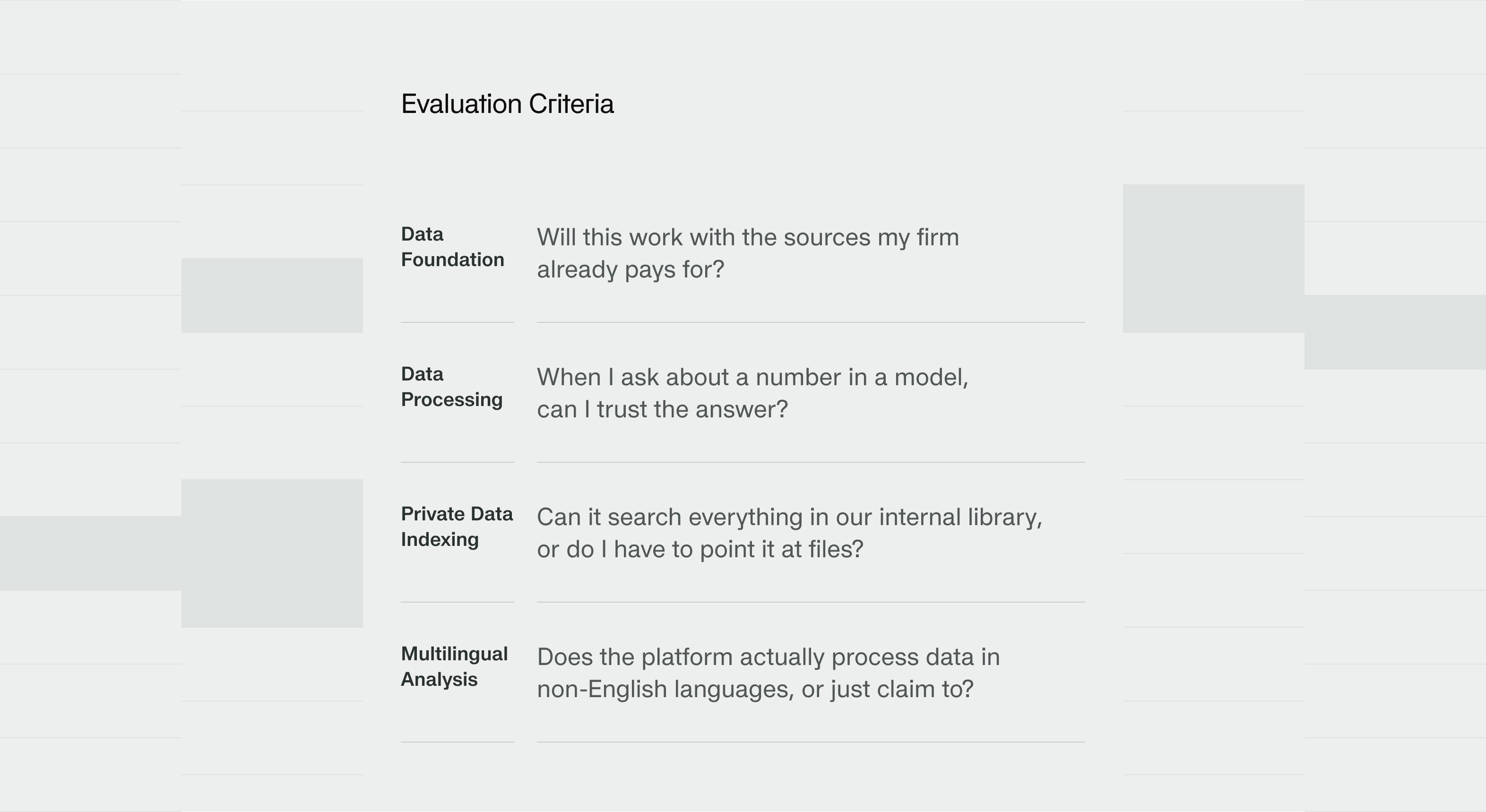
But vertical positioning alone doesn't mean a platform is the right fit for your firm. The differences that matter are in the architecture: what data the platform actually connects to, how it handles your internal documents, whether it processes structured financial data correctly, and whether it works in the languages your team operates in.
This post compares ten vertical AI platforms built specifically for institutional finance — excluding general-purpose LLMs and pure data providers — across four criteria that reflect how investment teams actually evaluate these tools.
How to Choose the Right Platform
Before evaluating specific tools, it helps to ask yourself these questions:
What data does your workflow depend on? Licensed institutional data — Bloomberg, FactSet, Preqin, broker research — should be native to the platform you use, not bolted on through plugins.
How precise do your outputs need to be? For anything where a wrong number or a missed document has material consequences, the underlying architecture matters.
What does your internal data environment look like? A firm with a large, complex private document library — deal files, research archives, internal models — needs a platform that can search across all of it intelligently.
Do you operate across multiple languages? For firms with exposure to Japanese, Korean, or other non-English markets, they need a platform that can ingest, index, and search internal documents written in those languages at scale.
1. AlphaSense
AlphaSense is the most legacy market intelligence platform in this comparison. Following its acquisition of Tegus, it combines broker research from 1,000+ Wall Street sources, 240,000+ expert call transcripts, regulatory filings, and 500M+ searchable documents in a single platform.
AlphaSense Strengths
Extensive content library for public markets research
Strong earnings transcript coverage with AI-generated Smart Summaries and sentiment analysis
Internal content integration via API and enterprise connectors
AlphaSense Limitations
Private data room search less sophisticated for large, complex internal libraries
Real-time news speed and multilingual document processing lag behind newer platforms
Very expensive — limits accessibility for smaller or mid-sized firms
2. Hebbia
Hebbia is a Generative AI platform that handles large volumes of financial documents simultaneously, organizing results in a grid that makes cross-document comparison fast and auditable. Most PE and legal teams cite it for high-volume deal room document analysis.
Hebbia Strengths
Strong for document-heavy financial workflows like due diligence and deal analysis
Full AI reasoning transparency with every step auditable through grid matrix
Handles unlimited document volumes
Hebbia Limitations
No native connection to Bloomberg, FactSet, Preqin, or broker research — all third-party data must be uploaded
No real-time market tracking, no charting capability
Limited report generation capabilities
3. Rogo
Rogo is a purpose-built AI platform for Investment Banking. It understands the financial data environment well and covers the core workflows: research synthesis, document Q&A, data retrieval.
Rogo Strengths
Purpose-built for investment banking with genuine domain depth
LSEG Workspace partnership and PitchBook/Crunchbase access for 150,000+ private companies
Excel, PowerPoint, and Word integrations align with daily IB workflows
Rogo Limitations
Private document search requires users to specify a document or folder first — does not search across an entire data room automatically
Real-time news tracking less comprehensive than Terminal X
Firm-templated report generation less developed
4. BlueFlame AI
BlueFlame operates as the AI layer within Datasite's M&A infrastructure. Its core value is workflow automation for alternative investment managers.
BlueFlame Strengths
Native integrations with DealCloud, Salesforce, Grata, and Microsoft Outlook — covers the core alternative investment tech stack
Full audit trail and compliant (SOC2; meets SEC, GDPR, GLBA)
BlueFlame Limitations
No Bloomberg, FactSet, or broker research connectivity — public market data limited to Quartr earnings call transcripts
No Excel-native processing or finance-specific document retrieval logic
No multilingual private document support
5. Boosted.ai
Boosted.ai focuses on capital markets research, portfolio analytics, and macro intelligence.
Boosted.ai Strengths
Finance-specific ML models trained on capital markets data — not a general-purpose LLM
API distribution model enables embedding in third-party platforms and white-label deployments
Mobile access and voice-powered research agents for on-the-go workflows
Boosted.ai Limitations
Private data room and internal document search not core features
Excel-native processing not highlighted — structured data handling unclear
Bloomberg and FactSet native connectivity not documented
Multilingual and APAC capabilities not documented
6. Brightwave
Brightwave is a private markets research platform. Its autonomous agents produce comprehensive research deliverables from large deal room document sets. Scope is deliberately narrow as it is built for private markets investment analysis only.
Brightwave Strengths
Agent orchestration produces finished, shareable research deliverables
Designed specifically for large deal room document environments
Background agents with fleet-level control for large document sets
Brightwave Limitations
No real-time market news, no Bloomberg/FactSet/broker research connectivity
No Excel-native processing, no structured data handling
Multilingual capability not documented — scope limited to English-language private markets
7. Hudson Labs
Hudson Labs is a public market research platform that uses proprietary finance-specific LLMs that the team reports outperform general-purpose models on finance benchmarks. It focuses exclusively on US public equities.
Hudson Labs Strengths
Proprietary LLMs purpose-built for financial document types
Forensic risk and earnings quality scoring for all US issuers over $300M market cap
Verbatim earnings call summaries with full source citations
Hudson Labs Limitations
US public equities only — no private markets, no deal data rooms, no sell-side broker research by default
No multilingual private document support
No charting or visualization features
8. Reflexivity
Reflexivity is an AI investment analytics platform that combines S&P Global, LSEG Datastream, Cboe, and Nasdaq data with explainable AI.
Reflexivity Strengths
Pre-bundled institutional data (Refinitiv, Nasdaq, S&P)
Knowledge graph of interconnected market relationships enables macro-oriented analysis
Explainable AI with full audit trail
Reflexivity Limitations
No private data room processing or internal document search
Limited broker research and alternative data coverage
No multilingual private document support
9. Auquan
Auquan is an autonomous agent platform for institutional financial services, covering credit analysis, investment research, ESG, and compliance workflows.
Auquan Strengths
End-to-end autonomous workflow execution that completes credit analysis and research workflows independently
Broad multilingual data coverage with 2M+ data sources in 76+ languages
Works across private and public data simultaneously
Auquan Limitations
Structured financial data handling such as excel processing is limited
Real-time market news depth limited
10. Terminal X
Terminal X is an AI Analyst platform built for institutional investors—not a chatbot or search engine, but a system designed to replicate how analysts and portfolio managers operate at scale. It parses filings, builds trade theses, stress-tests models, and synthesizes research across dozens of sources.
By unifying public data, firm institutional memory, and user-specific context into a single environment, it enables analysts to move from raw inputs to submission-ready Investment Memos without switching tools.
Terminal X Strengths
Native connectivity to Bloomberg, FactSet, Preqin, broker research, and 100M+ external sources based on client entitlements
Indexes millions of internal documents—investment memos, models, comps, broker reports, emails—with retrieval logic tailored to each document type
Processes Excel and financial models deterministically via code, not LLMs—eliminating hallucination risk on structured data
Ingests and analyzes Korean and Japanese financial documents at scale, with contextual understanding of market-specific language and tone
Generates production-grade Investment Memos, market wraps, and comp analyses formatted to the firm's exact template — submission-ready, not draft-ready
Terminal X Limitations
Newer to market; brand recognition still building relative to AlphaSense and Rogo
Fewer public case studies and third-party reviews than more established competitors
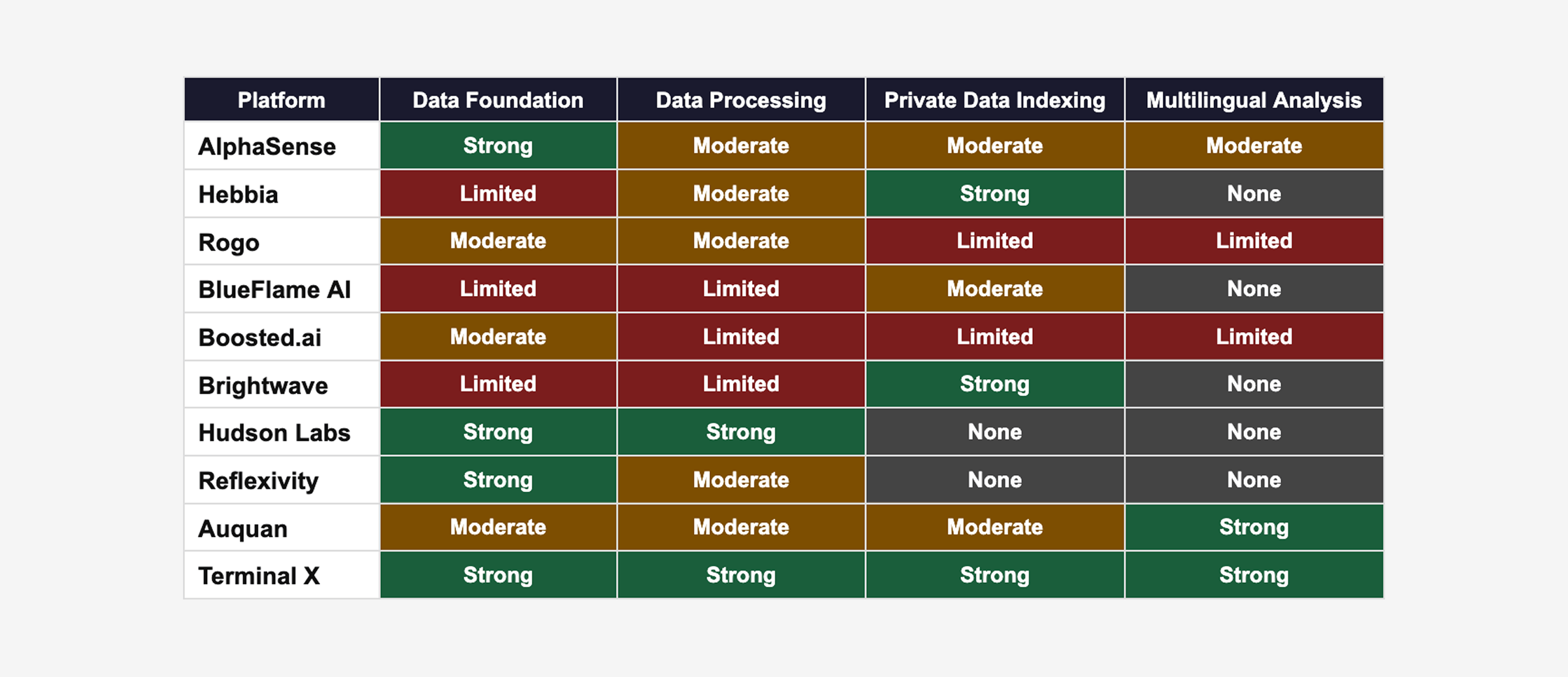
Evaluation Matrix
All ten platforms rated across the four criteria. Ratings reflect documented capabilities based on publicly available product information and platform positioning.
Final Thoughts
The vertical AI platforms in this comparison are genuinely capable, and most of them solve at least one problem well. AlphaSense has the deepest public markets content library. Hebbia has document-intensive due diligence. Rogo has real traction in investment banking workflows.
The harder question is which platform handles all four problems simultaneously and which ones require you to stitch together workarounds. For firms with complex data environments, that distinction has real workflow and accuracy consequences.
Terminal X is built for firms that need all four to work — the institutional data layer, the precision on structured data, the private document intelligence, and the multilingual depth. If that describes your environment, it is worth a closer look.